
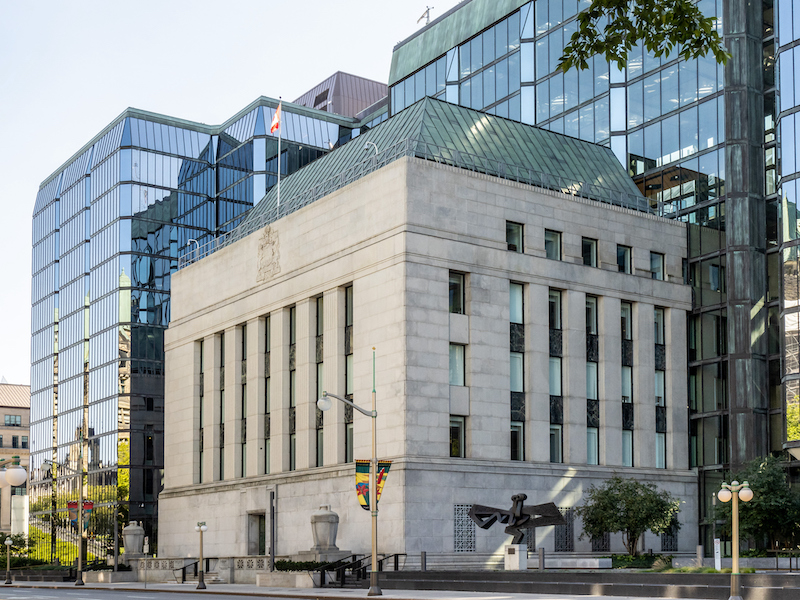
Economic growth projections dimmed a bit in the latest survey of financial market participants by the Bank of Canada.
The median GDP forecast for 2025 came in at just 0.6% in the latest survey, which was conducted between Sept. 19 and Oct. 1. Respondents included banks, investment dealers, pension funds, insurers and asset-management and research firms.
The median reading was down from the previous forecast of 0.8% in the June 25 to July 3 survey. The forecast for 2026 was also a bit weaker, ticking down to 1.7% in the current survey, from 1.8%.
The list of downside risks to these forecasts remained unchanged, with the prospect of rising trade tensions leading the way, cited by 90% of respondents, followed by weaker consumer spending (63%) and a weaker housing market (40%).
Concerns about the consumer have increased, while housing market worries retreated slightly. In the previous survey, both were cited by 44% of respondents, while the threat of escalating trade conflict led the way at 89%.
The top upside risk remains the prospect of an easing of trade tensions, cited by 87% of respondents, followed by larger-than-expected fiscal stimulus (80%) — the survey took place before last week’s federal budget — and looser monetary policy (40%).
The prospect of a recession remained little changed in the latest survey, with 35% seeing a possible recession in the next six months, 30% expecting one in the next six to 12 months, 25% worrying about a recession in 12 to 18 months, and 23% anticipating a recession in 18 to 24 months.
The median inflation forecast also eased a bit in the latest survey, with the median expectation for headline inflation coming in at 2% for the end of 2025, the end of 2026, and the next five years. In the previous survey, the median forecast for inflation at the end of this year was 2.2%.
And, expectations for monetary policy were little changed from the prior survey, with the median forecast for the policy interest rate coming in at 2.25% for the end of 2025, remaining at that level through 2026 and into 2027, before picking up to 2.5% by the third quarter of 2027.
However, the balance of risks around the path for interest rates has shifted, with 63.4% of respondents now seeing the risks skewed to a lower rate path, and just 3.3% seeing the risks skewed to a higher path. In the previous survey, 42.3% saw risks skewed to a higher path, and 34.6% had the risks skewed lower.