
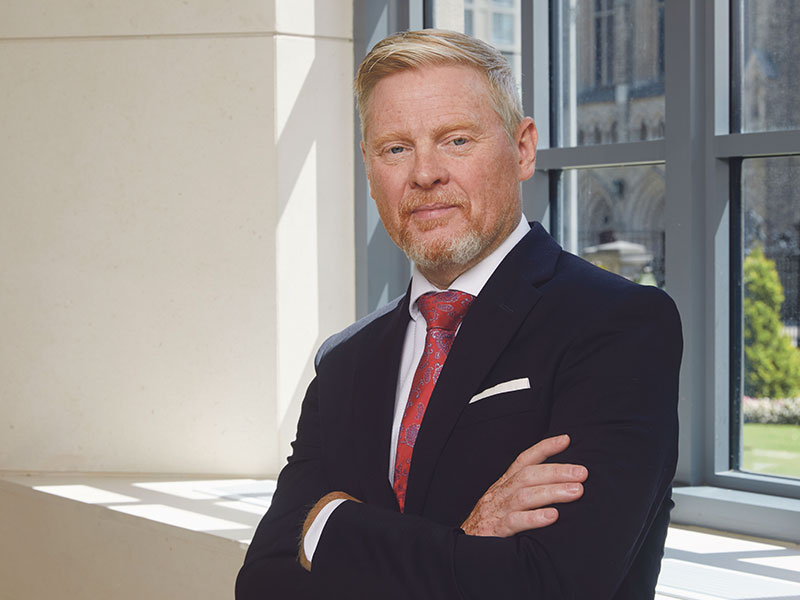
Richard McIntyre has been in the wealth management industry since 1997. He cut his teeth at the Standard Life Assurance Company in the U.K. before moving to Montreal, where he became vice-president, sales operations, with Standard Life Mutual Funds, in 2000. He left Standard years before its 2015 acquisition by Manulife, serving stints as executive vice-president for Dundee Wealth Financial Advisory before its acquisition by Bank of Nova Scotia and then as Scotiabank’s senior vice-president and head of Scotia Private Client Group.
He would eventually join the Manulife fold in 2021, as head of sales at what was then Manulife Securities. A year later, McIntyre was tapped to take over the president and CEO office from Rick Annaert, who’d been in the role for 17 years. In September 2024, he also took on the role of head of Canadian wealth management, saying the position was “particularly exciting” based on Manulife’s intention to grow in the wealth space.
There wasn’t much time for McIntyre to celebrate, however. It was clear that the firm — since rebranded Manulife Wealth — was “long overdue” for a transformation, the firm said at that time.
“We are changing the way we show up for our advisors,” McIntyre said back in 2022. His mission was clear: make Manulife Canada’s “best wealth management firm.”
The dealer hasn’t yet achieved that.
Consider the annual results of Investment Executive’s (IE) Dealers’ Report Card, in which 11 firms are assessed by their advisors across 25 criteria each year. In 2021, coinciding with McIntyre’s first year, Manulife advisors gave their firm an overall rating of 7.9 out of 10. The dealer has since received IE ratings of 7.2 in 2022, 6.9 in 2023 and 7.2 in 2024. This year’s result was even lower, at 6.1. (IE ratings are calculated as the average of all of a company’s category ratings by advisors in the Report Card, excluding the Net Promoter Score®.)
Change is hard
In McIntyre’s view, these results should be seen in the context of his change agenda. “We are in the midst of a significant transformation,” he said, “one that balances technology, operational excellence and the support we provide advisors, their teams and clients.”
Technology has been a persistent issue for the firm.
In 2023, Manulife swapped out Broadridge Financial Solutions’ wealth platform for Fidelity Clearing Canada’s (FCC) uniFide digital and back-office tools. Broadridge had been in place about two decades prior to that change, but Manulife said it couldn’t customize the legacy platform any further to suit its needs. Its FCC implementation was completed last year.
In 2024, Manulife was identified by its advisors as among the most improved dealers in IE’s Dealers’ Report Card. In that year, advisors’ year-over-year ratings for four of seven technology suite categories reflected significant improvement compared with the dealer’s 2023 results. Those four improved areas were “client onboarding tools,” “client account statements & portals,” “general technology training & internal IT support” and “support for remote system access & transactions.”
But the dealer’s switch to FCC hasn’t been entirely smooth, with advisors reporting persistent teething problems. The 2025 Dealers’ Report Card showed Manulife Wealth’s results slipping in five of the seven technology suite categories — the only rating in that area that was positive year over year was the dealer’s result for “support for remote system access & transactions.” (See “What Manulife’s advisors said”.)
McIntyre compares the FCC implementation to an acquisition where both companies had to align processes and policies in a regulated environment.
“How do you thread the needle through the fact we’ve got different operating models and businesses [within Manulife], and then move them onto a platform that everyone is going to be happy with?” McIntyre said. He confirmed that all advisors are now on the FCC back-office platform, “as that’s our core infrastructure,” but said there is some flexibility for advisors when they choose planning software and client engagement tools.
The move to FCC hasn’t been the only technology change the firm has made. Last year, it rolled out new portfolio management and trading tools from Envestnet, and financial planning software from Conquest Planning. Other preferred programs include Salesforce for client relationship management and the firm’s unified managed account platform. Said McIntyre, “These are industry-leading tools and platforms that we expect advisors will increasingly gravitate toward, [creating] consistency, efficiency and scalability across the business.”
With these shifts, Manulife Wealth has to get advisors used to working differently. For example, on the old Broadridge platform, advisors could phone someone in the back office for help. That process has changed, he said, now incorporating a ticketing system for service issues. There are also dedicated relationship managers at each branch and support staff who can accommodate on-demand meeting requests, he added.
For the firm’s investment and mutual fund advisors, of which there are nearly 1,000, moving to a new process meant the loss of “decades of familiarity,” McIntyre said. He’s working with FCC, to “align the end-to-end processes of our business, to make sure that there’s complete consistency [and] understanding of how we’re running our business. I sincerely appreciate everyone’s adaptability as we continue to refine our processes,” he said.
While all of this is meant to help advisors, McIntyre’s realistic. “Platforms and new programs mean very little if the day-to-day experience doesn’t meet expectations.” The business has “significantly increased” support staff levels and worked on their training, he said. But, “With new team members and operational methods, there is naturally a learning curve.”
The cost to serve
These technology investments must be recouped, even as the firm continues to help advisors navigate the changes. That reality triggered a new pain point: fee changes that included a $60 annual charge for client-name accounts, making it potentially uneconomical to service clients with low asset levels.
For McIntyre, it’s an unavoidable cost. “Every business has a cost-to-serve model,” he said. “We have to figure out a way of making sure that we can continue to grow our business and we need earnings to do that. I don’t want to do it at the expense of clients, but there’s also a realization that the cost of operating has gone up fairly dramatically.”
The cost of interacting with a client doesn’t scale with revenue, he explained. It’s just as expensive to serve someone with $50,000 in assets as it is someone with $500,000.
McIntyre wants to use technology to serve younger clients with fewer assets. As they accumulate more wealth, a more personal touch can be introduced affordably. “It’s not easy to provide advice to everybody in the same way because, frankly, the economics are just different,” he said. “As [clients] get older, that’s where there’s more human involvement.”
Prior to this, Manulife Wealth hadn’t changed its fee structure in 15 years.
What Manulife advisors said
IE’s 2025 Dealers’ survey was conducted by telephone in March and April, around the same time Manulife Wealth announced its fee changes. It was also a period in which advisors were fielding anxious calls from investors worried about a trade war with the U.S The dealer’s advisors were asked to reflect on various criteria, of which pay was only one element, but they didn’t hold back.
An advisor with the dealer in Quebec explained that the fee changes would eat into their earnings. “If we subtract the fixed costs charged, the remuneration is no longer competitive.”
“I disapprove [of] the changes and how it’s [been] done,” said an advisor with the firm in the Prairies. “The timing is terrible. It’s been a really tough year for Manulife advisors.”
As for the switch to FCC, some advisors were frustrated.
“The back office from Manulife Wealth is pretty responsive,” said an advisor in B.C. “But from FCC, it is terrible.”
“Ever since they split the middle and back office there’s been a huge disconnect,” said another advisor in B.C. “As a result, we can’t contact them [FCC] directly. If we do, it has to be through a ticket. The service level is very low. The middle office had a new staff shakeup, and they all have no idea what they’re doing.”
“[We] used to have an advisor support line, but now advisors end up teaching [the] back office what’s going on,” said an advisor with Manulife in the Prairies.
An advisor in Ontario pinned at least some of the technology issues on Manulife Wealth leadership: “They have not implemented the FCC rollout very well.”
We invited FCC to respond. “Manulife Wealth and FCC partnered to deliver one of the largest platform conversions in Canadian wealth management, migrating [more than] 423,000 accounts and $54 billion in assets,” said Kevin Barber, president with FCC, in an emailed statement. He said transitions of this magnitude “naturally introduce changes to familiar workflows,” but he also pointed to what he felt were significant benefits.
Through uniFide, for example, nearly all (97%) of new accounts can be opened electronically, “eliminating legacy paper-based pain points” during onboarding, Barber said. He pointed to automated transaction processes and an overall infrastructure that allows for business growth and “rapid innovation.”
Concerning advisor feedback, Barber said “dedicated service pods” were launched and there’s an advisor onboarding team that provides “consistent support.” The vendor offers Q&A sessions, webinars, training, focus groups and feedback forums, all of which allow advisors to “shape platform enhancements,” he added. “FCC remains committed to continuous improvement,” working alongside Manulife Wealth.
Overall, during Manulife advisors’ interviews with IE, multiple references were made to a lack of responsiveness among Manulife Wealth’s executives.
“Advisors feel like they don’t have a say,” said one of the firm’s advisors in Ontario.
“They come off disingenuous and seem to be out of touch on how advisors operate and [make] a lot of tone-deaf decisions,” said an advisor in B.C.
Then this, from another Manulife advisor: “[It] feels like the company has been more focused on profit than the advisors and clients. … [The leadership] only takes Slido questions on Zoom [or] Teams calls when it works for them. Otherwise, leadership talks at [advisors] rather than to them.”
Manulife Wealth is a huge organization, with approximately 950 advisors across the country. It’s “a broad range of advisors” with varying specialties, business requirements and experience levels, said McIntyre. “Getting that right from a cultural perspective is actually quite challenging because people want different things.”
The firm works with an advisory council that meets monthly. Added to that are eight subgroups who advise firm leadership on areas like women in wealth, the needs of future advisors and advisor planning needs.
“[There are] over 100 advisors who we engage with on a monthly basis, to try and navigate the complexity of what we’re trying to do,” McIntyre said.
“While we don’t always get it right, I know we need to keep learning from advisor feedback to ensure we’re moving in the right direction. That learning is what shapes our priorities, and we’ll continue working hard to close the gap between our intent and advisor perception.”
2025 Report Card highlights
A quick look at Manulife Wealth’s topline Dealers’ Report Card results and business details.
Parent company: Manulife Financial Corp.
Number of advisors in Canada: 950 (doesn’t include MGA business)
Assets: More than $60 billion in assets under management and administration, as of June 30
Dual-registered under CIRO: Yes
Highest-rated Report Card category by advisors (performance) in 2025: Freedom to make product choices (rated 9.0 out of 10)
Lowest-rated Report Card category by advisors (performance) in 2025: Receptiveness to advisor feedback (rated 3.8)
Most improved area of firm support year over year: Support for remote system access & transactions (rated 8.1 from 7.4 in 2024)
Category with most room to improve: Receptiveness to advisor feedback (rated 3.8, compared with the 7.8 performance average benchmark)
What advisors want the firm to most improve: Communication with advisors; clarity of the dealer’s strategy; the digital suite, smoothing out current issues.
Which firm features advisors like best: Manulife’s brand recognition and business-model flexibility
Most important area of support to the firm’s average advisor: There was a split between firm culture, advisor pay and the technology suite.
This article appears in the September 2025 issue of Investment Executive. Read the digital edition or read the articles online.