
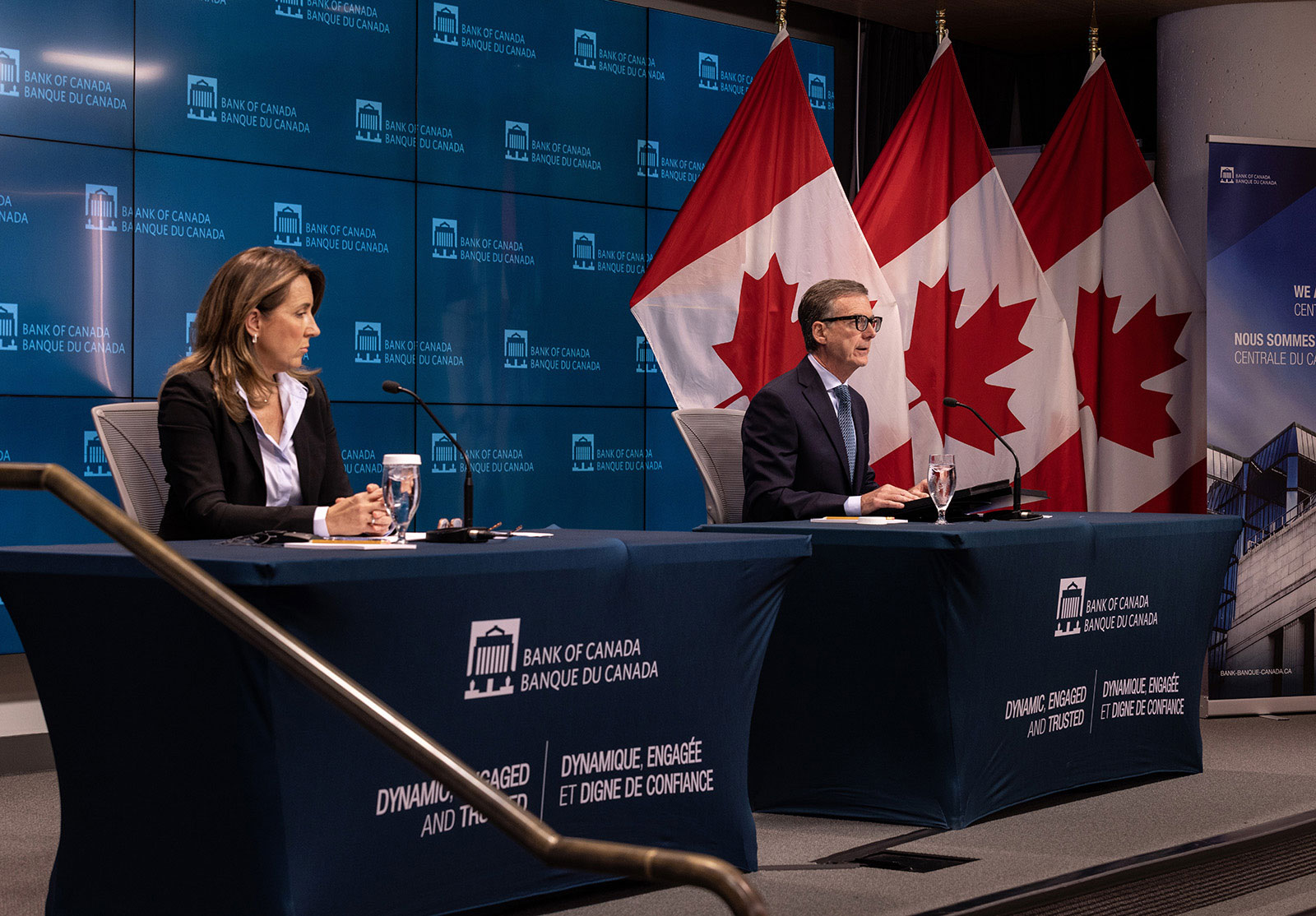
The head of the Bank of Canada says the country waited too long to reduce its economic dependence on the United States and is paying the price today.
Governor Tiff Macklem was in Saskatoon Tuesday giving a speech about global trade disruption to Saskatchewan business leaders.
He warned that U.S. President Donald Trump’s tariffs have hit trade-sensitive industries hard in Canada and put economic growth on a permanently lower trajectory.
To break free of its reliance on the U.S. economy, Macklem said Canada needs to develop new global markets for its products and remove internal barriers hampering productivity.
He compared the situation to the 2008-09 global financial crisis and the spillover effects a U.S. collapse had on Canada at the time.
“Everyone talked about diversification then, too. But not much happened,” Macklem said in his speech.
Afterward, he told reporters that Canadian businesses lost “urgency” when the recession faded and U.S. demand returned.
The United States will likely always be Canada’s largest trading partner, he said.
But Macklem added that Canada and the U.S. aren’t going through a “cyclical downturn” this time, and there won’t be a bounceback in growth unless business leaders and policymakers restructure parts of the economy.
“This time, we need to follow through,” he said.
The Bank of Canada lowered its benchmark interest rate by a quarter point to 2.5% last week as signs of weakness in the economy shifted the risks away from rising inflation.
Real gross domestic product fell in the second quarter of 2025 as Canadian exports dropped; Canada’s labour market is also showing cracks, particularly in tariff-hit industries.
Exemptions under the Canada-U.S.-Mexico agreement are shielding most Canadian goods from U.S. tariffs, though sector-specific duties on steel, aluminum, autos and softwood lumber are hurting those industries. Macklem noted China’s tariffs on Canadian canola are having the sharpest effect on the Saskatchewan economy.
The impact from U.S. tariffs has so far been more muted than first feared, Macklem said, but he warned the full fallout is yet to be seen.
He said Canada has already begun taking steps to protect the economy against future disruption, but argued the hard work must start now.
Macklem called for better east-west transportation corridors and improvements to port infrastructure to help get Canadian goods to overseas markets. Those efforts could reduce Canada’s reliance on U.S. markets and make better use of existing free-trade agreements.
He also pushed for the end of interprovincial trade barriers, harmonizing regulatory frameworks across provinces, and shortening approval times to boost Canadian productivity.
Combined, Macklem said these measures could lift Canada’s economic growth above the trajectory seen before the U.S. tariff disruption.
“Canadian leaders — business, political and economic leaders — need to chart a new course. We should have been making these changes 15 years ago. But the next best time is now,” he said.
Macklem also weighed in on Trump’s efforts to influence and reshape the U.S. Federal Reserve, the Bank of Canada’s counterpart south of the border.
Trump has ordered the removal of Fed governor Lisa Cook in a case set to be decided by the U.S. Supreme Court, and reportedly considered firing Federal Reserve Chair Jerome Powell.
The Fed, like the Bank of Canada, cut its policy rate by a quarter point last week, though Trump had pushed for faster easing.
Macklem said during his speech that Trump’s attempts to influence the Fed “are raising questions about the continued independence of U.S. monetary policy.”
“The lesson from history is clear … central banks that have operational independence for monetary policy do a better job at delivering price stability for its citizens,” he later told reporters.
Macklem also warned that threats to financial stability in the United States will have knock-on effects globally and are already “starting to have consequences in financial markets.”
He added that his U.S. counterpart Powell “is doing a very good job under very trying circumstances, and he is guiding monetary policy based on evidence, not politics.”