
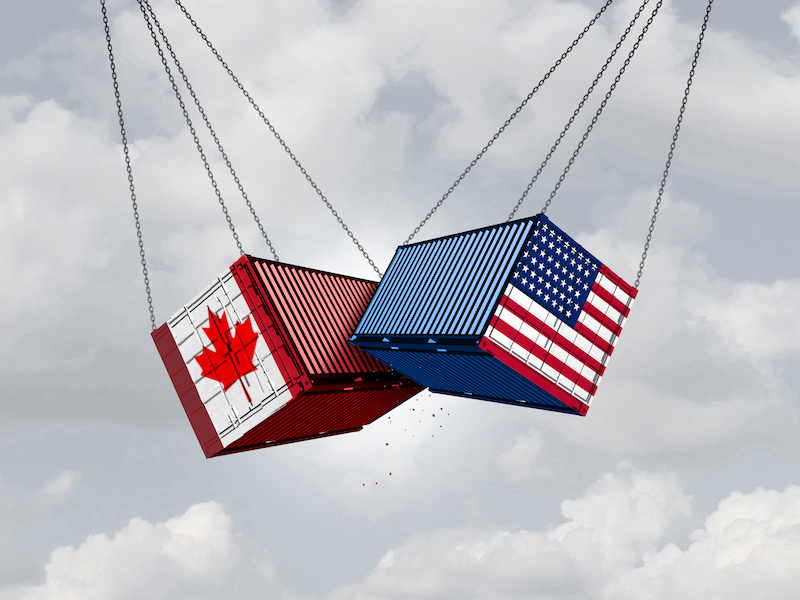
The actual tariff rate that Canadian exports to the U.S. are facing lags the rate that’s predicted by various tariff announcements — while that gap faces conflicting forces in the year ahead, Desjardins Group says the actual rate won’t reach the heights signalled by the predicted rate.
In a report published Wednesday, economists at Desjardins noted that, recently, the gap between the actual and predicted effective tariff rates has been widening — driven by several factors, “including shifting trade patterns, administrative issues, delayed payments and legacy exemptions.”
The fact that the actual rate, around 3.9%, hasn’t reached the predicted rate, 7.2%, is a good thing for the economy, the report said.
If the gap disappeared, “our outlook for Canada’s economy and labour market would be much weaker,” Desjardins said.
Looking ahead, there are likely to be conflicting forces affecting the gap.
For one, Canadian exporters are continuing to increase their compliance with the CUSMA trade agreement, which exempts them from certain U.S. tariffs — keeping the actual rate from reaching the predicted rate.
At the same time, however, the escalation of sector-specific tariffs — in autos, steel, aluminum and copper — will be pushing the actual rate in the other direction, and they show no sign of coming down.
“A reduction in sector‑specific tariffs seems unlikely at present, as the U.S. is showing no interest in negotiating,” the report noted.
Taken together, Desjardins said it believes that the effective tariff rate will have peaked in the fourth quarter of 2025 at approximately 3.9%, and will ease to somewhere around 3.6% by mid‑ to late‑2026.
“Assuming no additional measures, as well as increased compliance and lower trade volumes in most targeted sectors (except aluminum), tariff pressures should slowly ease through 2026,” it said.
However, the ongoing threat of new tariffs adds uncertainty to the outlook, the report acknowledged.
“The breadth of recent trade policy changes — combined with uncertainty around the upcoming CUSMA review and lack of meaningful progress in de‑escalating trade tensions — suggests that tariffs will remain a structural headwind to growth,” it said.