
Prime Minister Mark Carney says it’s no coincidence U.S. President Donald Trump’s latest tariff threat against Canada comes just ahead of negotiations on renewing North America’s main free-trade pact.
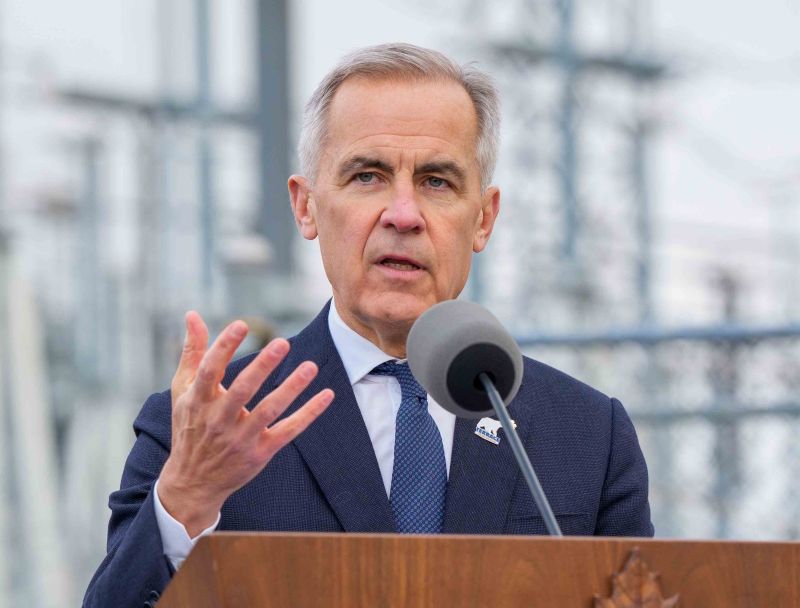
“The president is a strong negotiator and … I think some of these comments and positioning should be viewed in the broader context of that,” Carney said at an unrelated announcement in Ottawa on Monday.
In a weekend social media post in which he referred to Carney as “governor,” Trump threatened to impose 100% tariffs on Canadian goods if Ottawa reaches a trade deal with China.
In subsequent posts, Trump wrote that “China is successfully and completely taking over the once Great Country of Canada,” adding “I only hope they leave Ice Hockey alone!”
Carney said he won’t respond to every social media post or comment made by the president.
The prime minister became a target of Trump’s anger after he made a widely praised speech at the World Economic Forum in Davos, Switzerland, last week.
In his comments, which were later cited by European leaders, Carney warned that the old world order is dead and urged middle powers to band together as larger ones try to pressure them through economic coercion.
Carney said Monday that his WEF comments were a recognition of how the world has changed and “Canada had understood the scale of the change” well before other countries.
Trump originally expressed support for Ottawa’s agreement with China but he changed tune after Carney’s speech. Members of the Trump administration have warned Ottawa’s recent deal with China could upend negotiations on the Canada-U.S.-Mexico Agreement on trade, known as CUSMA, which are set to take place this year.
The prime minister has maintained his new agreement with Beijing to sort out longstanding trade tensions over electric vehicles and agricultural products is consistent with CUSMA.
The negotiations that led to CUSMA, which replaced the North American Free Trade Agreement, served as an early stress test for Ottawa during the first Trump administration. There were tensions and Trump repeatedly threatened tariffs, but ultimately a deal was signed that all three countries hailed a success.
The trade agreement’s future is much less certain now, as Canada, Mexico and the United States prepare for the mandatory review. Earlier this month, Trump said the trade deal was “irrelevant” to him.
Trump previously called the deal “transitional” and, during a meeting with Carney at the White House last October, the president said it may have served its purpose.
U.S. Trade Representative Jamieson Greer has said the Trump administration is also considering splitting up the three-way pact and negotiating separate deals with Canada and Mexico.
Carney said he expects the CUSMA review to be “robust.”
CUSMA has shielded Canada and Mexico from the worst impacts of Trump’s tariffs. The president increased duties on Canada to 35% last August, citing the cross-border flow of deadly fentanyl as justification. Those tariffs do not apply to goods compliant with CUSMA.
Canadian industries are also being slammed by separate tariffs on goods like steel, aluminum, automobiles, lumber and cabinets.
— With files from Kelly Geraldine Malone