
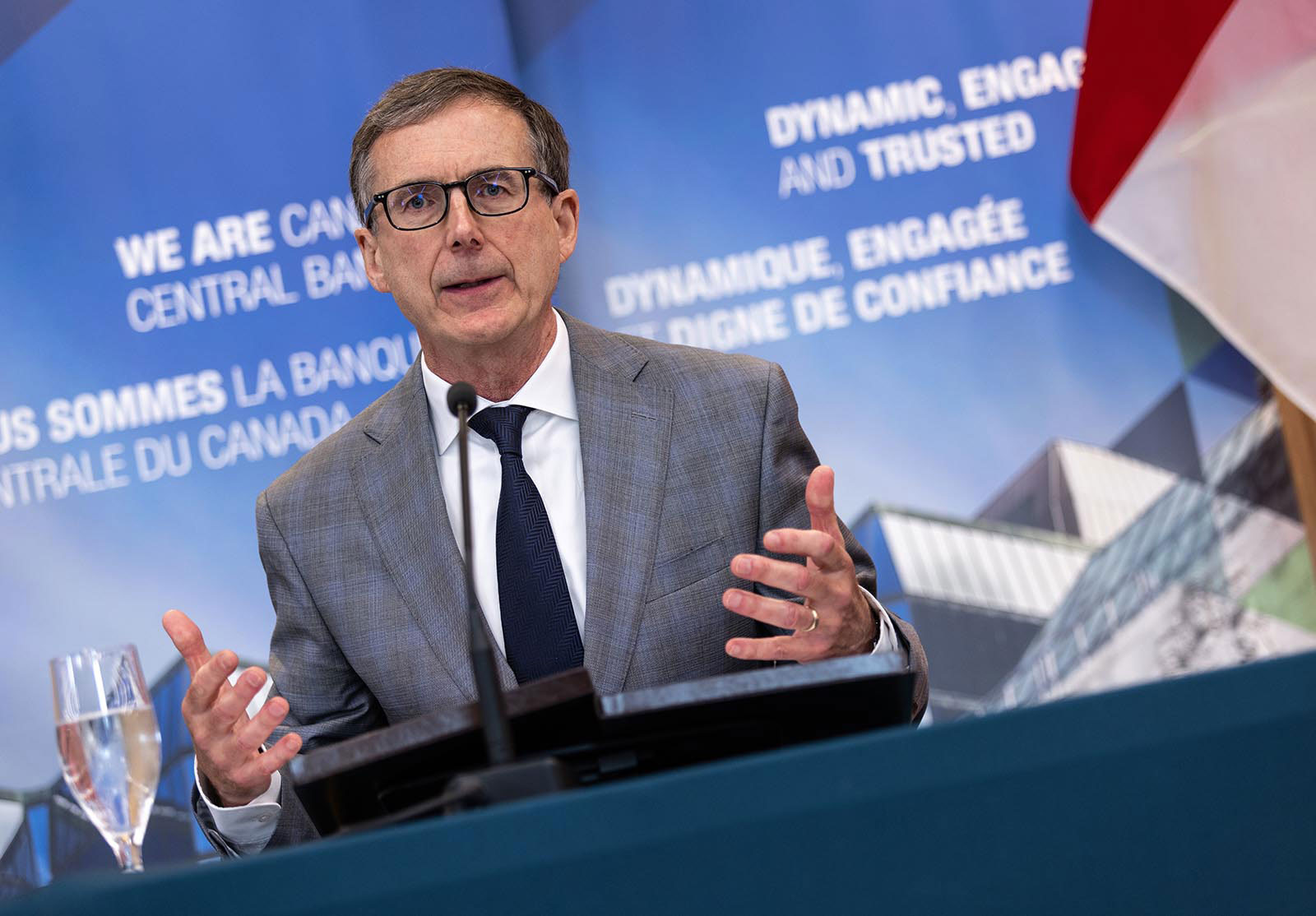
Bank of Canada governor Tiff Macklem says businesses ought to “lean into” the forces disrupting the economy or risk failing to adapt.
Macklem gave a speech to the Empire Club of Canada in Toronto on Thursday where he told the business crowd how “structural changes” like U.S. tariffs, artificial intelligence and slowing population growth are affecting the economy.
He said in prepared remarks that while businesses are holding back investment and hiring plans in the face of U.S. protectionism, they’ve also been slow to adopt new AI technologies.
The Bank of Canada is forecasting weak growth in the economy over the next two years as businesses adjust to those disruptive forces. Macklem sought to rally the business crowd to embrace the changes already underway in the economy.
“We can be victims of U.S. tariffs and AI disruption, or we can lean into structural change, expand our internal market, diversify our trade, embrace new technology and raise our productivity,” he said.
Macklem also warned that slowing immigration and a declining fertility rate are putting Canada’s population on a slower growth track in the coming years.
As a result, he said the Bank of Canada expects the labour force will “hardly grow at all” over the next few years.
“That means fewer new consumers and workers in the economy, which lowers our economic potential,” Macklem said.
The central bank still expects businesses to be restrained in their hiring this year, thanks mostly to an uncertain outlook. With muted labour force growth in the forecast, the bank is not expecting the unemployment rate to trend much higher than the 6.8% recorded in December.
Macklem said the bank expects gradual improvement in the labour market in the years to come, but the structural changes affecting the economy mean the improvement could be uneven across sectors and occupations.
The Bank of Canada is not seeing much impact from AI in the labour market, Macklem said, though there is some early evidence that the technology is reducing the number of entry-level positions, which may in turn be boosting youth unemployment. Right now, it’s hard to separate the effects of AI from trade and demographic shifts in the jobs market, he noted.
The economic transition the central bank sees on the horizon could arrive sooner if trade uncertainty eases and businesses move quickly to invest in new technology and markets, Macklem said. He also warned that the economy could fail to adapt, and GDP and productivity might not recover, driving worse job and wage growth and a less affordable Canada.
“That’s what we really can’t afford. That’s why we need to lean into this structural change,” he said.
Macklem told reporters after his speech that the scenario where Canada doesn’t adapt to the new reality isn’t the Bank of Canada’s base case. Government support is helping businesses pivot and find new markets, he noted, and he expects the restructuring he’s pushing is already underway.
Macklem also said Thursday that this transition will be measured in years, not quarters, but at the end of it, Canada’s economy will be more resilient to external shocks.
“It will take some time. It will involve some difficult adjustments. But if the alternative is not making those difficult adjustments, the ultimate outcome will be worse.”
Macklem said the Bank of Canada, which held its policy rate steady at 2.25% last week, will work to smooth out these structural changes but noted that monetary policy cannot directly address any of the forces reshaping the economy.
One of the questions the central bank is trying to figure out is how much of the current economic weakness is structural and how much is cyclical.
Macklem said that if all of the current slowdown was tied to a cyclical downturn in the economy, it would be natural for the Bank of Canada to offer more stimulus to act as a tailwind.
“But the fact that some of it is structural means that if we lower rates too much, that will stoke inflation down the road,” he said.
The central bank signalled last week that it’s satisfied for now keeping the policy rate at the low end of its neutral range where many economists expect monetary policy is offering a slight boost to the economy.
The bank’s next interest rate decision is set for March 18.