
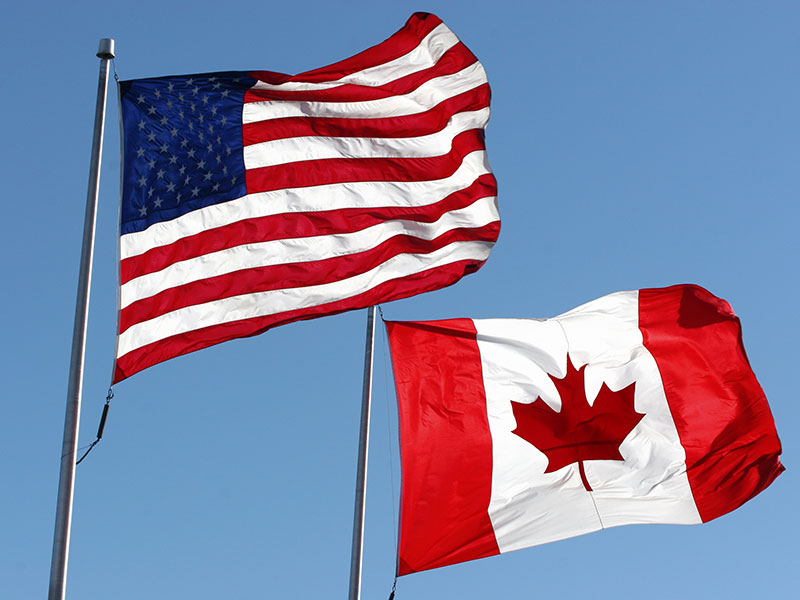
The U.S. economy will barely feel it if the scheduled review of the North American trade deal, CUSMA, runs aground, but Canada would be hit hard — and faces a possible recession next year if the deal dies, according to Desjardins Group.
In a report published Wednesday, the firm’s economists analyze the possible fallout from the upcoming CUSMA review, which is slated to begin as of July 1. Their base case is that the trade deal is renewed, and that its exemptions from various other tariffs are sustained, but it also examines a couple of more negative scenarios.
In the adverse scenario, the trade deal isn’t renewed, and it remains in effect for 10 years, subject to annual reviews — but the CUSMA-related exemptions are eliminated as of 2027.
And, in the “severe” adverse scenario, the U.S. withdraws from the deal entirely, leaving Canada with a 35% tariff on most goods, and 25% tariffs on Mexico.
In any scenario, the U.S. economy isn’t dramatically affected, but the adverse and severe adverse scenarios “will have an undisputed negative impact on the Canadian economy,” the report said.
For 2026, the impact would likely be limited, it noted, as a U.S. withdrawal wouldn’t take effect until Jan. 1, 2027.
“However, 2027 growth is likely to be materially weaker in the adverse scenario and significantly weaker in the severe adverse scenario,” the report said. “Indeed, a recession is likely in the first half of 2027 in the severe adverse scenario, followed by a shallow recovery.”
Longer term, real GDP growth would be permanently weakened in the adverse scenarios, and labour markets would face negative fallout too, with slower job growth and higher unemployment.
This weakness would also subdue inflationary pressures, it said, although that could be offset by a weaker loonie that results in higher import prices.
In terms of monetary policy, the negative economic fallout would likely lead the Bank of Canada to lower interest rates, the report said, with rates cut by 50 basis points in the third quarter of this year in the adverse scenario, and 75 bps in the severe adverse scenario.
For financial markets, “Risk assets would probably come under pressure, but less than intuition suggests,” the report said.
“Financials would feel some strain, especially where integration with U.S. markets is deepest, and energy prices might fall on the prospect of weaker global demand. But a spike in demand for precious metals should help offset some of those losses,” it noted.
In the U.S., equities should be relatively unscathed, it said, “any wobbles would be more about inflation or global appetite for U.S. assets than a purely domestic demand scare.”
At the economic policy level, a “severe adverse outcome would probably intensify ongoing debates about economic sovereignty, the development of domestic industrial supply chains and the need to reorient supply chains from a north-south axis to an east-west one,” the report said.
However, these kinds of policy shifts will take several years to materialize, and may not succeed.
“And even if Canada manages to avoid the worst-case scenario, the country still needs to diversify, build on its strengths and improve its productivity and ability to innovate. One thing is clear: achieving real economic sovereignty will require sustained, long-term commitment,” the report concluded.