
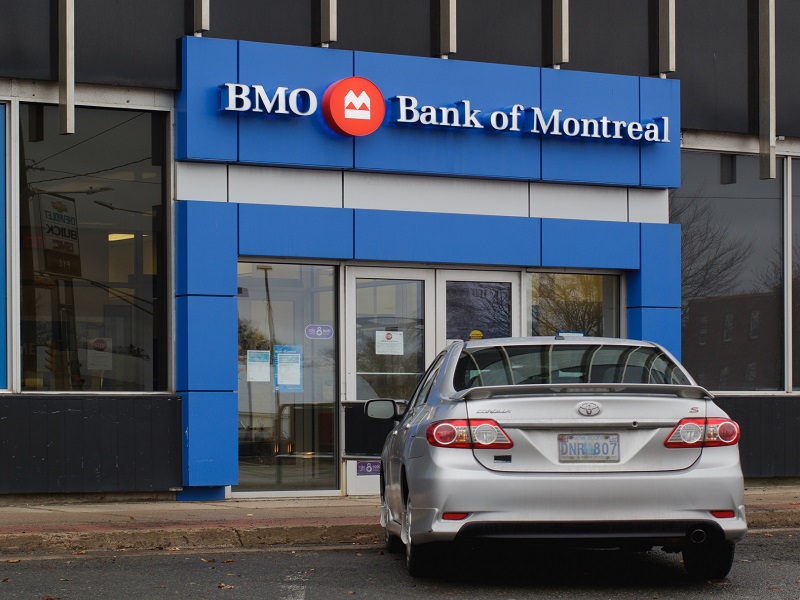
BMO Financial Group reported a rise in profits that beat analyst expectations despite charges related to layoffs and increased signs of strain for Canadian consumers.
The bank reported a first-quarter profit of $2.49 billion, up from $2.14 billion a year earlier as it had strong fee growth in its market-driven businesses and margin expansion in its Canadian and U.S. banking units.
“We’re executing on our commitment to deliver higher returns and profitable earnings growth,” said chief executive Darryl White on an earnings call Wednesday.
BMO has also pushed on operational efficiency, taking a $202 million pre-tax severance charge in the quarter. Bank filings show its total employee head count is down by 678 to 53,035 compared with its third quarter.
“Our commitment to expense management and operational efficiency continues to enable strategic investments in technology and talent,” said White.
The bank’s provisions for credit losses for the quarter amounted to $746 million, down from $1.01 billion.
The declines were largely from its U.S. banking operations as it continues to off-load some of its lower-performing loans and the business environment improves in the country.
Canadian personal and business banking showed provisions of $354 million, up about 9% from a year ago as elevated unemployment and other pressures continue.
While its mortgage book remains fairly stable, impaired provisions in credit cards have been steadily climbing to represent 5.97% of the portfolio. That’s up from 5.28% a year earlier, and up from 3.24% in the first quarter of 2024.
“We see stress at the lower end of the market,” said Mathew Mehrotra, head of Canadian personal banking at BMO.
“That’s a broad phenomenon in the country. It is more visible for us.”
He said the bank has made adjustments where it sees risks elevated, while it’s also focusing growth efforts in its premium card business.
In contrast, only 0.04% of residential mortgages were covered by impaired provisions, up from 0.03% a year ago, and the bank said it sees continued stability in the portfolio.
It said customers will see an average of a 7%, or $150 monthly payment increase this year, while 36% of clients will renew at a lower monthly payment.
While existing mortgages remain stable, the bank says growth remains muted with 2% loan growth over a year earlier.
Chief risk officer Piyush Agrawal said loans are performing as expected but headwinds remain.
“We continue to operate in an environment of modest economic growth across North America, with the U.S. economy maintaining its outperformance relative to Canada,” he said on the call.
The U.S. side of the business is doing better as the country sees expansionary fiscal policies, supportive monetary policy and AI investments, while in Canada, the overhang of trade issues and the renegotiation of the North American trade deal is creating significant uncertainty.
“Given these factors, we continue to anticipate a softer economic environment in Canada.”
While pressure is pronounced in higher-leveraged borrowers, the bank is prioritizing proactive client engagement to help limit issues, he said.
And while headwinds remain, the bank saw revenue for the quarter climb to $9.82 billion, up from $9.27 billion a year earlier.
On an adjusted basis, BMO says it earned $3.48 per diluted share in its latest quarter, up from an adjusted profit of $3.04 per diluted share a year earlier.
Analysts on average had expected an adjusted profit of $3.20 per share in the quarter, according to LSEG Data & Analytics.
The earnings beat was largely thanks to its capital markets division, said Scotiabank analyst Mike Rizvanovic in a note.
“Canadian (personal and commercial) banking and U.S. banking both came in below our estimate, wealth management was in line, while capital markets was a big beat, and the adjusted loss in corporate came in lower than we had expected.”
The bank’s wealth management business earned $352 million, up from $328 million, while its capital markets business earned $657 million, up from $589 million a year earlier. This reflected higher revenue from stronger global markets and net sales, as well as balance growth, partially offset by higher expenses.
BMO completed the acquisition of Burgundy Asset Management Ltd. in November, and its results are included in the wealth management business.
Insurance net income was $79 million for the quarter, down $4 million from a year prior.
The bank says its Canadian personal and commercial banking business earned $948 million, up from $877 million a year ago, helped by an increase in revenue, as well as a lower provision for credit losses, partially offset by higher expenses.
In the U.S., BMO says its banking operations earned $742 million, up from $635 million a year earlier, as it faced headwinds from a weaker U.S. dollar.