
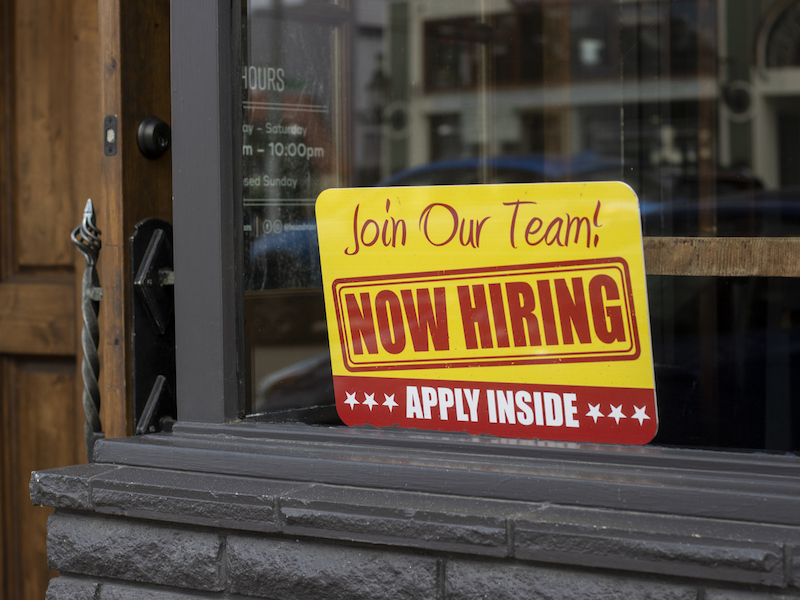
U.S. employers added just 22,000 jobs last month as the labour market continued to cool amid uncertainty over President Donald Trump’s economic policies.
Hiring decelerated from 79,000 in July, the Labor Department said Friday, and came in below the roughly 80,000 economists had expected for August. The unemployment rate ticked up to 4.3%, also worse than expected and the highest level since 2021.
When the Labor Department released a disappointing jobs report a month ago, an enraged Trump fired the economist in charge of compiling the numbers and nominated a loyalist to replace her.
Talking to reporters Thursday night at a dinner with wealthy tech executives, Trump shrugged off the U.S. jobs data before it landed. “The real numbers that I’m talking about are going to be whatever it is, but will be in a year from now,” the president said.
Factories shed 12,000 jobs in August, the fourth straight month of payroll cuts in manufacturing. Construction companies cut 7,000 jobs, and the federal government 15,000.
Healthcare and social assistance companies – a category that spans hospitals to daycare centres – added nearly 47,000 jobs last month and now account for 87% of private-sector jobs created in 2025.
Labor Department revisions lopped 21,000 jobs off June and July payrolls and revealed employers had cut 13,000 jobs in June, the first monthly job losses since December 2020, when the job market was disrupted by the Covid pandemic.
So far this year, the economy is generating fewer than 75,000 new jobs a month, less than half the 168,000 jobs added per month last year and not even a quarter of the 400,000 jobs added monthly in the hiring boom of 2021-2023.
The U.S. job market has lost momentum partly because of the lingering effects of 11 interest rate hikes by the Federal Reserve in 2022 and 2023, and partly because Trump’s policies, including sweeping tariffs on imports from almost every country, have created uncertainty that leaves managers reluctant to hire.
“The warning bell that rang in the labor market a month ago just got louder,” Olu Sonola, head of U.S. economic research at Fitch Rates, wrote in a commentary. “It’s hard to argue that tariff uncertainty isn’t a key driver of this weakness.”
Democrats quickly seized on the report as evidence that Trump’s policies are damaging the economy and hurting Americans.
“Americans cannot afford any more of Trump’s disastrous economy. Hiring is frozen, jobless claims are rising, and the unemployment rate is now higher than it has been in years,” said Rep. Richard Neal of Massachusetts, ranking Democrat on the House Ways and Means Committee. “The president is squeezing every wallet as he chases an illegal tariff agenda that is hiking costs, spooking investment, and stunting domestic manufacturing.”
Workers’ average hourly earnings rose 0.3% from July and 3.7% from August 2024, exactly what forecasters expected. The year-over-year figure is nearing the 3.5% many economists see as consistent with the Federal Reserve’s 2% inflation target.
Josh Hirt, senior economist at financial services firm Vanguard, said the tumbling payroll numbers reflect a reduced supply of workers – the consequence of an aging U.S. population and reduced immigration. “We should get more comfortable seeing numbers below 75,000 and below 50,000 new jobs a month,” he said. “The likelihood of seeing negative jobs numbers is higher.”
The weak numbers make it nearly certain the Federal Reserve will cut its benchmark interest rate at its next meeting, Sept. 16-17. Under chair Jerome Powell, the Fed has been reluctant to cut rates until it sees what impact Trump’s import taxes have on inflation.
Hirt expects the Fed to reduce its benchmark rate – now a range of 4.25% to 4.5% – by a full percentage point over the next year and said it might cut rates at each of its next three meetings.
Trump has repeatedly pressured Powell to lower rates and sought to fire one Fed governor, Lisa Cook, over allegations of mortgage fraud, which Cook says was a pretext to gain control of the central bank.
He blamed Powell again for slowing jobs numbers Friday in a social media post, saying, “Jerome ‘Too Late’ Powell should have lowered rates long ago. As usual, he’s ‘Too Late!’”
After the worrisome July jobs numbers, Trump fired Erika McEntarfer, head of the Bureau of Labor Statistics, claiming the hiring report had been rigged to hurt him politically. He has nominated a partisan ideologue, E.J. Antoni, to replace her. For now, pending Antoni’s confirmation by the Senate, the jobs report is in the hands of acting BLS commissioner Bill Wiatrowski, a career Labor Department official.