
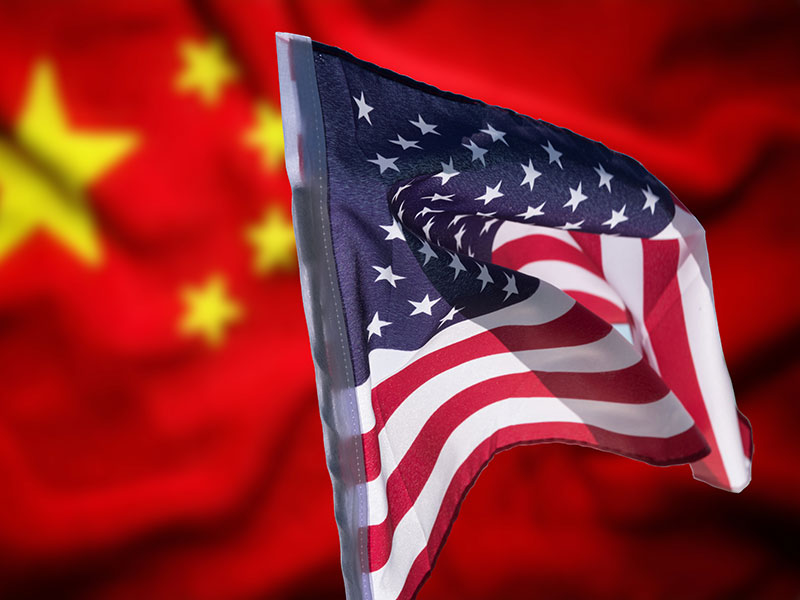
Top trade officials from China and the United States launched a new round of talks Monday in a bid to ease tensions over tariffs between the world’s two largest economies.
U.S. Treasury Secretary Scott Bessent and Chinese Vice Premier He Lifeng met at the offices of Sweden’s prime minister for two days of talks, which Bessent has said will likely lead to an extension of current tariff levels.
Other possible outcomes will be scrutinized by markets and businesses for signs of a rapprochement, following brinkmanship earlier this year.
Analysts say the talks could set the stage for a possible meeting between U.S. President Donald Trump and Chinese President Xi Jinping later this year.
Issues on the agenda include access for American businesses to the Chinese market, Chinese investment in the U.S., components of fentanyl made in China that reach U.S. consumers, Chinese purchases of Russian and Iranian oil, and American efforts to limit exports of Western technology — including chips that power artificial intelligence systems.
The talks ended for the day after nearly five hours Monday and were set to reconvene Tuesday morning.
‘Large and confident partner’
Wendy Cutler, a former U.S. trade negotiator and now vice-president at the Asia Society Policy Institute, said Trump’s team would face challenges from “a large and confident partner that is more than willing to retaliate against U.S. interests.”
Rollover of tariff rates “should be the easy part,” she said, warning that Beijing has learned lessons since the first Trump administration and “will not buy into a one-sided deal this time around.”
“Beijing is more prepared and will insist on movement on U.S. tech export controls at a minimum — a difficult ask for Washington,” she said, adding that many conversations will take place in the lead-up to any Xi-Trump summit.
“Success is far from guaranteed,” Cutler said. “There are numerous trip wires that can throw a wrench in this preparatory process.”
The U.S.-China trade talks are the third this year, nearly four months after Trump upended global trade with sweeping tariff proposals, including an import tax that rose to 145% on Chinese goods. China retaliated with tariffs reaching 125% against U.S. goods, sending global financial markets into a temporary tailspin.
Extending a 90-day pause
The Stockholm meeting, following earlier talks in Geneva and London, is set to extend a 90-day pause on those tariffs. During the hiatus, U.S. tariffs were lowered to 30% on Chinese goods, while China set a 10% tariff on U.S. products.
The Trump administration, which just completed a deal on tariffs with the European Union, wants to reduce a trade deficit of US$904 billion last year, including nearly US$300 billion with China.
China’s Commerce Ministry said last week the “consultations” would raise shared concerns through the principles of “mutual respect, peaceful coexistence and win-win cooperation.”
The talks with Beijing are part of a flurry of U.S. trade negotiations set off by Trump’s arm-twisting “Liberation Day” tariffs against dozens of countries. Since then, some talks have produced deals. Others have not.
Without an extension by Aug. 12, the tit-for-tat tariffs between the U.S. and China could snap back to the triple-digit levels seen before the 90-day pause reached in Geneva. Many other countries — including some developing ones that depend on U.S. exports — face a Friday deadline, as the Trump administration said letters will go out beforehand with set rates.
Critics say Trump’s tariffs penalize Americans by forcing U.S. importers to absorb the cost or pass it on to consumers through higher prices.
Suggestion of stability
On Friday, Trump told reporters “we have the confines of a deal with China” — two days after Bessent told MSNBC that a “status quo” had been reached between the two sides.
While China has offered little guidance about the specifics of its aims in Stockholm, Bessent has suggested the situation has stabilized enough for the two countries to begin looking toward longer-term balance between their economies.
For years, since China entered the global trading system about two decades ago, the U.S. has pushed leaders in Beijing to boost domestic consumption and open markets to foreign-made — including American — goods.
Other sticking points include China’s industrial overcapacity and concerns about whether Beijing is doing enough to control chemicals used to make fentanyl, analysts say.
In Stockholm, the Chinese are likely to demand the removal of a 20% fentanyl-related tariff imposed by Trump earlier this year, said Sun Yun, director of the China program at the Washington-based Stimson Center.
Looking long-term
Experts say long-term progress in the U.S.-China trade relationship will hinge on structural changes.
That includes increased manufacturing in the U.S., part of Trump’s broader ambition. On the Chinese side, that could mean reducing excess production in sectors like electric vehicles and steel, and boosting consumer spending to ease imbalances in its export-driven economy.
Sean Stein, president of the U.S.-China Business Council, said the Stockholm talks offer an opportunity for both governments to address structural reform. Businesses will watch for clues about a possible Trump-Xi summit, because any real deal will depend on a meeting between the two leaders, he said.
A deal is possible, he added, because “a lot of the things that the U.S. wants, the Chinese want as well.”
China, for example, is interested in buying U.S. soybeans, aircraft and parts, and Chinese businesses are interested in investing in U.S. manufacturing — which aligns with Trump’s goal of reindustrialization.
Bessent has also said the Stockholm talks could address China’s purchases of Russian and Iranian oil.