
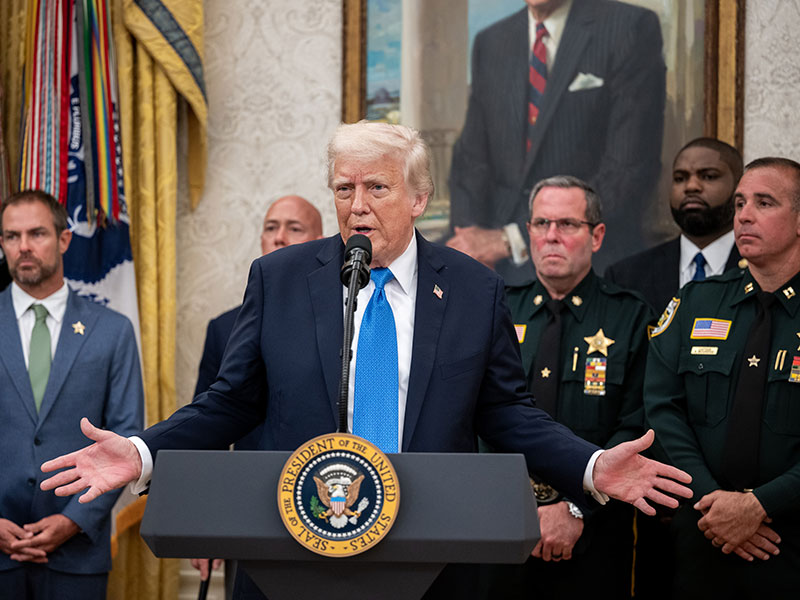
The United States will impose a 25% tariff on goods from India, plus an additional import tax due to India’s purchase of Russian oil, President Donald Trump said Wednesday.
India “is our friend,” Trump said on his Truth Social platform, but its tariffs on U.S. products “are far too high.”
The Republican president added that India buys military equipment and oil from Russia, enabling Moscow’s war in Ukraine. As a result, he intends to charge an additional “penalty” starting Friday as part of his administration’s revised tariffs on multiple countries.
Trump told reporters Wednesday the two countries were still in the middle of negotiations on trade despite the tariffs slated to begin in a few days.
“We’re talking to India now,” the president said. “We’ll see what happens.”
The Indian government said Wednesday it is studying the implications of Trump’s tariffs announcement.
India and the U.S. have been engaged in negotiations on concluding a “fair, balanced and mutually beneficial” bilateral trade agreement over the last few months, and New Delhi remains committed to that objective, India’s trade ministry said in a statement.
Trump’s view on tariffs
Trump’s announcement comes after a slew of negotiated trade frameworks with the European Union, Japan, the Philippines and Indonesia — all of which he said would open markets for American goods while enabling the U.S. to raise tax rates on imports. The president views tariff revenues as a way to help offset budget deficit increases tied to his recent income tax cuts and generate more domestic factory jobs.
While Trump has effectively wielded tariffs as a cudgel to reset the terms of trade, the economic impact is uncertain, as most economists expect a slowdown in U.S. growth and greater inflationary pressures, with some of the tax costs passed along to domestic businesses and consumers.
There is also the possibility of more tariffs coming on trade partners with Russia, as well as on pharmaceutical drugs and computer chips.
Kevin Hassett, director of the White House National Economic Council, said Trump and U.S. Trade Representative Jamieson Greer would announce the Russia-related tariff rates on India at a later date.
Tariffs face European pushback
Trump’s approach of putting a 15% tariff on America’s long-standing allies in the EU is generating pushback, possibly causing European partners — as well as Canada — to seek alternatives to U.S. leadership on the world stage.
French President Emmanuel Macron said Wednesday, in the aftermath of the trade framework, that Europe “does not see itself sufficiently” as a global power. Speaking in a cabinet meeting, he said negotiations with the U.S. would continue as the agreement is formalized.
“To be free, you have to be feared,” Macron said. “We have not been feared enough. There is a greater urgency than ever to accelerate the European agenda for sovereignty and competitiveness.”
Seeking a deeper partnership with India
Washington has long sought to develop a deeper partnership with New Delhi, which is seen as a bulwark against China.
Indian Prime Minister Narendra Modi has established a good working relationship with Trump, and the two leaders are likely to further boost cooperation between their countries. When Trump met with Modi in February, the U.S. president said India would start buying American oil and natural gas.
The new tariffs on India could complicate its goal of doubling bilateral trade with the U.S. to $500 billion by 2030. The two countries have had five rounds of negotiations for a bilateral trade agreement. While the U.S. has been seeking greater market access and zero tariffs on almost all its exports, India has expressed reservations about opening sectors such as agriculture and dairy, which employ much of the country’s population, Indian officials said.
The Census Bureau reported that the U.S. ran a $45.8 billion trade imbalance in goods with India last year, meaning it imported more than it exported.
With a population exceeding 1.4 billion, India is the world’s largest country and a possible geopolitical counterbalance to China. India and Russia have close relations, and New Delhi has not supported Western sanctions on Moscow over its war in Ukraine.
The new tariffs could put India at a disadvantage in the U.S. market relative to Vietnam, Bangladesh and, possibly, China, said Ajay Sahai, director general of the Federation of Indian Export Organisations.
“We are back to square one, as Trump hasn’t spelled out what the penalties would be in addition to the tariff,” Sahai said. “The demand for Indian goods is bound to be hit.”