
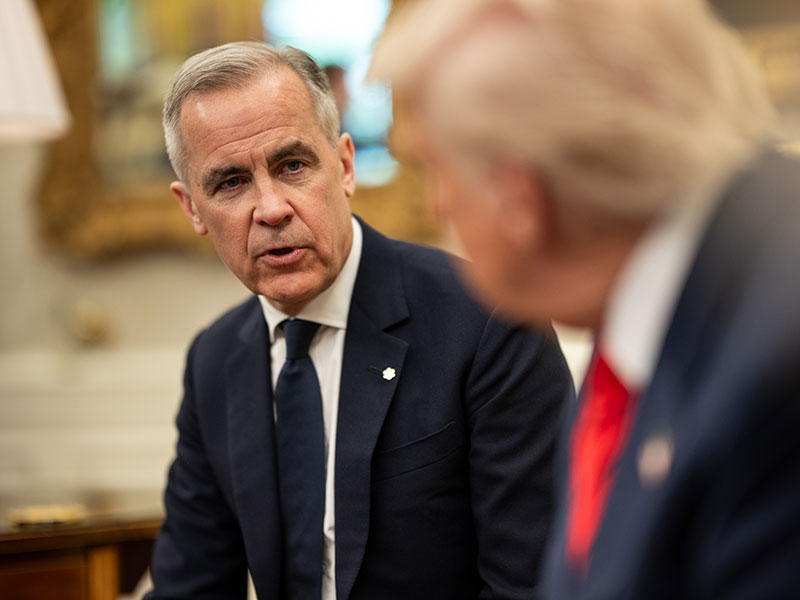
Canada will drop some retaliatory tariffs on American products to match U.S. tariff exemptions for goods covered under the Canada-United States-Mexico Agreement, Prime Minister Mark Carney announced Friday.
After meeting with his cabinet, Carney said at a news conference the decision will take effect Sept. 1, 2025.
Carney and U.S. President Donald Trump spoke on a call Thursday, and Carney confirmed Trump assured him the move would help kick-start trade negotiations with the U.S.
Carney said Canada and the U.S. have re-established free trade for the vast majority of goods. He said Canada will retain tariffs on steel, aluminum and autos as it works with the U.S. to resolve issues.
“Indeed, our focus is squarely on these strategic sectors and the future,” he said.
Carney said the average U.S. tariff rate on the world has jumped from just over 2% at the end of last year to almost 16%.
“Canada currently has the best trade deal with the United States,” Carney said, noting the U.S. average tariff rate on Canadian goods is 5.6% and remains the lowest among all its trading partners.
“While it’s different from what we had before, it is still better than that of any other country.”
Speaking to reporters Friday in Washington, D.C., Trump said Carney’s choice to remove tariffs was “nice” and that the leaders would have another call “soon.”
“We had a very good call,” Trump said. “I like him.”
Trump said he was “fighting for the United States” but that he was “working on something” and wants to be “very good to Canada.”
A White House official said in a statement that Canada’s move was “long overdue.”
The official said they looked forward to “continuing our discussions with Canada on the administration’s trade and national security concerns.”
Ontario Premier Doug Ford said in a social media post that he spoke with Carney after the announcement to stress that any agreement with the U.S. needs to provide “relief to our tariff-impacted sectors, including steel, auto, forestry and copper.”
“If the federal government can’t achieve that, they need to hit back hard against U.S. tariffs and provide additional supports for the workers and businesses in these sectors,” Ford said.
Carney said the Canadian government will begin its preparations for the CUSMA review process due next year by launching consultations next month. He said the review process can take anywhere between six and 18 months.
Canada imposed 25% tariffs on a long list of American goods in March, including oranges, alcohol, clothing and shoes, motorcycles and cosmetics.
A readout from Carney’s office after Thursday’s call with Trump described the meeting as “productive and wide-ranging.”
It said the leaders talked about trade challenges and the new economic and security relationship between the two countries.
Following his conversation with Trump, Carney said Canada and the United States will “intensify” their discussions to address current trade challenges in strategic sectors and to seize “major immediate opportunities” in trade, investment and security.
‘Comprehensive’ industrial strategy
“As we develop our new trade relationship with the United States, Canada will continue to take all measures necessary to support Canadian workers, our businesses and our consumers,” Carney said, noting the government will soon announce a “comprehensive industrial strategy” that protects Canadian jobs, boosts Canadian competitiveness, buys Canadian goods and diversifies Canadian exports.
Carney said the government will also soon select the first in a series of new major projects that will “connect and transform our economy.”
The Canadian Federation of Independent Business said in a statement Friday that it welcomes the decision to drop some retaliatory tariffs on U.S. goods.
“This is a step in the right direction and will take some of the pressure off Canadian small businesses as trade talks continue,” said Corinne Pohlmann, the CFIB’s executive vice-president for advocacy.
Pohlmann said many small business owners have said Canada’s retaliatory measures were almost as damaging as the U.S. tariffs. She said nearly six in 10 small firms reported they were hurt by Canada’s counter-tariffs, with only steel and aluminum tariffs doing more harm.
“Those were not touched today, so the challenges for those businesses remain,” Pohlmann said.
While small firms were in favour of Canadian counter-tariffs when the trade war began, Pohlmann said their support has been falling since February.
“Today’s announcement provides some relief going forward; however, businesses have already paid millions of dollars in counter-tariffs,” Pohlmann said. “We urge Ottawa to immediately release its tariff revenue to small businesses directly and indirectly affected by trade disruptions and work quickly to resolve small business requests still tied up in the remissions process.”
— With files from Catherine Morrison and Kelly Geraldine Malone in Washington, D.C.