
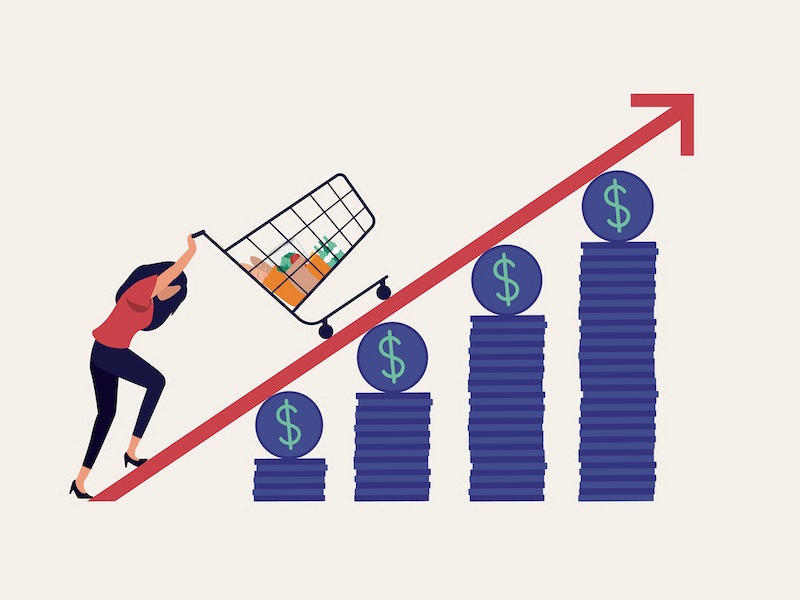
The annual rate of inflation accelerated to 2.4% in March as the war in Iran sent fuel costs soaring, Statistics Canada said Monday.
That’s a jump of more than half a percentage point from the headline inflation rate of 1.8% in February, though economists had widely expected the March figures to come in a tick higher.
Iran’s move to close of the Strait of Hormuz in response to U.S. and Israeli attacks and ongoing uncertainty over ceasefire talks has sent global fuel prices skyrocketing in recent weeks.
Statistics Canada said March’s 21.2% monthly increase in the price of gasoline was the largest on record. The agency said inflation would have been 2.2% in March if gasoline was taken out of the equation — a second consecutive monthly decline.
“It could have been worse,” BMO chief economist Doug Porter said of Monday’s inflation report in a note to clients.
The inflationary increase would have been even higher, Statistics Canada noted, but the federal government’s move to kill the consumer carbon price a year earlier was still taking some steam out of the annual inflation comparisons in March.
Monday also marks the start of Ottawa’s roughly four-month break on federal fuel excise taxes, a move expected to remove as much as 10 cents from a litre of gas and four cents per litre of diesel. Economists expect that move will take one-to-two tenths of a percentage point off the headline inflation rate starting in May.
Porter said he expects the headline inflation rate will still top 3% in April as gas prices kept rising heading into the month and the carbon tax removal drops out of the year comparison.
“However, depending on where oil prices go and how long the Strait remains closed, it’s possible that April will mark the high-water point for inflation this year,” Porter said, though he put emphasis on “possible.”
Food inflation, meanwhile, cooled to 4% from 5.4% in February as the lingering distortions of the federal government’s two-month “tax holiday” a year earlier fell out of the annual comparisons. That drove down inflation at restaurants and on some grocery items last month.
Fresh vegetable prices jumped 7.8% year-over-year in March, which Statistics Canada chalked up to recent tough growing conditions for cucumbers, peppers and celery.
The Bank of Canada will be paying close attention to the March inflation figures as it prepares for its next interest rate decision on April 29.
The central bank has signalled it will look through the initial inflationary spike tied to the Middle East conflict but will act to ensure higher gas prices don’t turn into longer-term inflation.
The Bank of Canada has held its benchmark interest rate steady at 2.25% since its last cut in October. Financial market odds are more than 90% in favour of another hold next week, according to LSEG Data & Analytics.
Porter noted that the drags on inflation in March were varied, as telephone services, auto insurance, furniture, candy, and mortgage interest costs all saw outright price declines on a monthly basis, suggesting underlying softness in the economy.
“Our considered view is that if it were not for the conflict with Iran, the discussion would currently be revolving around the strong possibility of BoC rate cuts, not hikes. This report reinforces that opinion,” he said.
Bradley Saunders, North America economist with Capital Economics, said in a note that the Bank of Canada will be pleased to see some progress on its preferred core inflation metrics despite the volatility in March’s headline number.
He said the central bank will be reading closely into price-setting behaviours from businesses to gauge whether firms plan to pass higher prices from the Iran war on to consumers.
The bank is set to release its own quarterly surveys of businesses and consumers later Monday morning.