
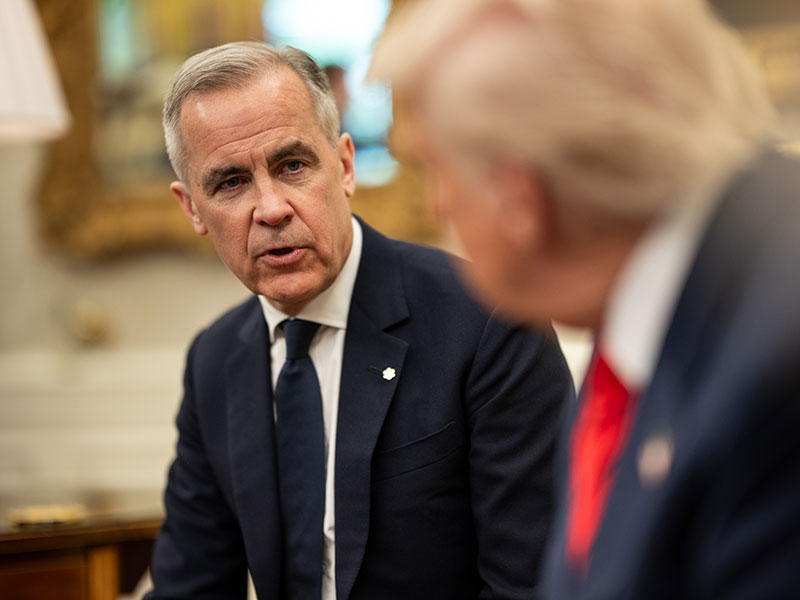
President Donald Trump said there is “mutual love” but “natural conflict” between the United States and Canada as he met with Prime Minister Mark Carney on Tuesday in the Oval Office.
Carney’s second visit to the United States comes as one of the world’s most durable and amicable alliances has been strained by Trump’s trade war and annexation threats. Topics up for discussion include trade and the United States-Mexico-Canada Agreement, which is critical to Canada’s economy and is up for review next year.
Trump said he was willing to revisit the free trade agreement, enacted during his first term, or seek “different deals.”
“We could renegotiate it, and that would be good, or we can just do different deals,” he said. “We’re allowed to do different deals.”
Trump showed a fondness for Carney that he did not display toward Carney’s predecessor, Justin Trudeau. He described Carney as a “world-class leader” and said he is a tough negotiator.
“We want Canada to do great,” Trump said. “But you know, there’s a point at which we also want the same business.”
Asked why the U.S. and Canada have failed to reach a deal on trade, Trump said it is a complicated situation.
“We have natural conflict,” he said. “We also have mutual love.”
Carney balked at the word “conflict.”
“There are areas where we compete, and it’s in those areas where we have to come to an agreement that works. But there are more areas where we are stronger together, and that’s what we’re focused on.”
Trump’s talk of making Canada the 51st state and his tariffs have left Canadians feeling a sense of betrayal, though he only made a joking reference to a “merger” between the two countries.
Relations with Canada’s southern neighbour and longtime ally have not been worse.
“We’ve had ups and downs, but this is the lowest point in relations that I can recall,” said Frank McKenna, a former Canadian ambassador to the United States and current deputy chairman of TD Bank.
“Canadians aren’t being instructed what to do. They are simply voting with their feet,” he said. “I talk every day to ordinary citizens who are changing their vacation plans, and I talk to large business owners who are moving reward trips away or executive business trips. There is an outright rebellion.”
There is concern in Canada over what will happen to the U.S.-Mexico-Canada Agreement. Carney is seeking relief on some sector-specific tariffs, but expectations are low.
“Improving relations with the White House ahead of the USMCA review is certainly an objective of the trip, but opposition parties and part of the Canadian public will criticize Prime Minister Carney if he doesn’t achieve some progress on the tariff front at this stage,” said Daniel Béland, a political science professor at McGill University in Montreal.
Carney has said the USMCA, up for review in 2026, is an advantage for Canada at a time when it is clear the U.S. is charging for access to its market. He noted that the U.S. commitment to the core of USMCA means more than 85% of Canada-U.S. trade remains tariff-free. He said the U.S. average tariff rate on Canadian goods is 5.6% and remains the lowest among all its trading partners.
But Trump has some sector-specific tariffs on Canada, known as Section 232 tariffs, that are having an impact. Steel and aluminum imports, for example, face 50% tariffs.
McKenna said he has heard Canada might get some relief on steel and aluminum. “It could be 50% to 25% or agreeing on tariff-free quotas to allow the steel and aluminum to go through at last year’s levels,” he said.
The ties between the two countries are without parallel. About US$2.5 billion (nearly $3.6 billion Canadian) worth of goods and services cross the border each day. Canada is the top export destination for 36 U.S. states. There is close cooperation on defence, border security, and law enforcement, and a vast overlap in culture, traditions, and pastimes.
About 60% of U.S. crude oil imports come from Canada, and 85% of U.S. electricity imports come from Canada.
Canada is also the largest foreign supplier of steel, aluminum, and uranium to the U.S. and has 34 critical minerals and metals that the Pentagon is investing in for national security.
“The bigger prize would be getting a mutual agreement to negotiate as quickly as possible the free trade relationship,” McKenna said. “If the United States were to threaten us with the six months’ notice of termination, I think it would represent a deep chill all across North America.”