Last week marked the first anniversary of U.S. President Donald Trump’s so-called Liberation Day. Executive Order 14257 laid out an extensive list of import duties, citing a national trade deficit emergency. Anxieties ran high in capitals around the world. Nowhere more, perhaps, than in Ottawa.
A year later, Washington’s trade policy disruption has had a less dramatic effect than many expected, according to a report published Wednesday by RBC Economics. Canada enjoyed per capita GDP growth for the first time in three years in 2025. Last year was also the first time since 2013 that foreign direct investment into Canada exceeded Canadian investment abroad.
As things stand, April 2025 looks mostly like a case study on the importance of a long-term view.
“It was a significant trade shock,” said one of the report’s authors, assistant chief economist Nathan Janzen, in an interview on Thursday. “But not everything that the U.S. administration has threatened to do has been followed through on.”
Manufacturers dependent on steel, aluminum and copper materials have suffered real pain. The automobile and softwood lumber industries have also been severely impacted. Regionally, Ontario and Quebec have been the two provinces hit hardest.
Still, in 22 U.S. states, Canada was the top exporter of goods last year. Nationally, we were second only to Mexico. That’s despite steel exports, for example, falling 30% in 2025.
“Most Canadian exports have been exempt,” Janzen said. “Almost 90% of our exports remain duty-free.”
Trump threatened to tear up the Canada-U.S.-Mexico Agreement (CUSMA) on trade last spring, but then quickly backed off.
Canadian policymakers chose to retaliate in a limited fashion, targeting items like Kentucky bourbon that would hurt U.S. companies and at the same time leave Canadian consumers with alternatives. It was clear early on that an all-out trade war with the U.S. would be ill-advised.
“There’s this huge share of Canadian trade that’s part of a deeply integrated supply chain with the U.S.,” Janzen said.
CUSMA talks
Canada and the U.S. have held preliminary talks on CUSMA, which is scheduled for a mandatory six-year joint review. The three countries are expected to decide on an agreement extension this year, although The Canadian Press reported this month that Jamieson Greer, the U.S. trade representative, doesn’t expect negotiations to be completed by July 1, the deadline for Washington to notify Ottawa and Mexico City of its plans for the pact.
Canada needs a deal. Prime Minister Mark Carney has begun the process of diversifying the country’s portfolio of trade agreements, but it’s early days yet. And that is sure to be a years-long project that will require massive investment.
“You need to start building infrastructure that would allow us to shift significantly more of our exports via, say, ocean transport rather than rail and truck,” Janzen told me.
It’s the right thing to do, he said, but “for a lot of Canadian exports, we don’t really have an option other than selling into the U.S. The best case scenario, at least in the foreseeable future, is trading with the U.S. It’s the largest consumer market, sitting right next door.”
There has been some discussion of a potential upswing in capital investment should CUSMA be renewed. Janzen is less optimistic about a capex rebound.
“It would be a positive,” he said. “I don’t know that it would be a huge change. Business investment has been pretty weak in Canada for more than a decade now.”
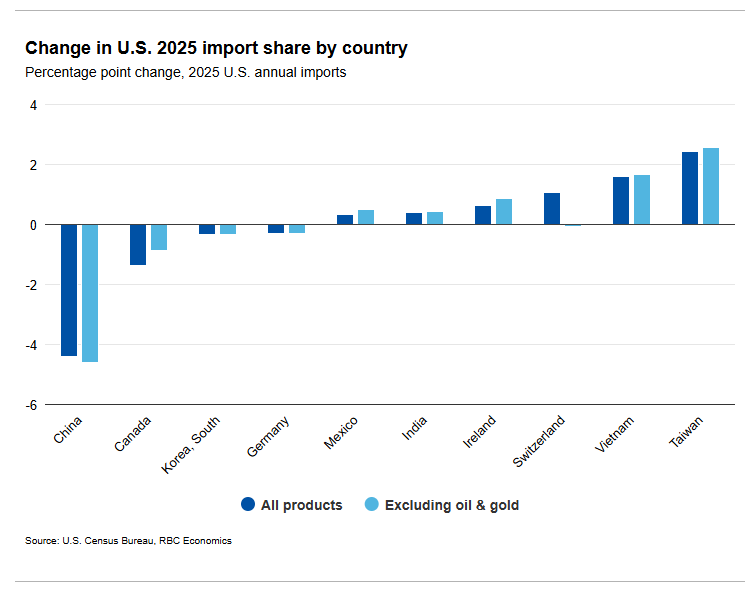
Meanwhile, there’s been little headway made on Trump’s goal to bring manufacturing back to the U.S. Imports from China were replaced largely with imports from other Asian countries. RBC reports that Americans bought 2.7% more on imported goods in 2025 than they did the year before, not counting price impacts.
Global trade didn’t slow either. CPB Netherlands Bureau for Economic Policy Analysis, an independent research organization, has reported a 4.4% increase in global trade — nearly twice the 2.3% growth recorded in the previous year.
A year later, Liberation Day feels less like a turning point than a stress test. The shock was real, but the global economy muddled through. North American trade remains entrenched.