
The advisors polled for Investment Executive‘s (IE) Dealers’ Report Card were facing — and continue to grapple with — both industry-wide and firm changes. Whether it was new leadership at their firm, a technology overhaul, or just general industry evolution, there were a lot of shifting factors affecting their businesses.
Still, for 2026 and across 25 areas assessed, the lowest benchmark performance average they gave their industry segment was 7.3 out of 10. That was for the social media training, content & rules category — the same as we saw in IE‘s Brokerage Report Card.
For the most part, the benchmark performance averages were 8.0 and above. Nine of the 12 firms assessed also received IE ratings of 8.0 or higher, with each of their results suggesting they’re trying to innovate and include advisors in the conversation. (See main results table.)
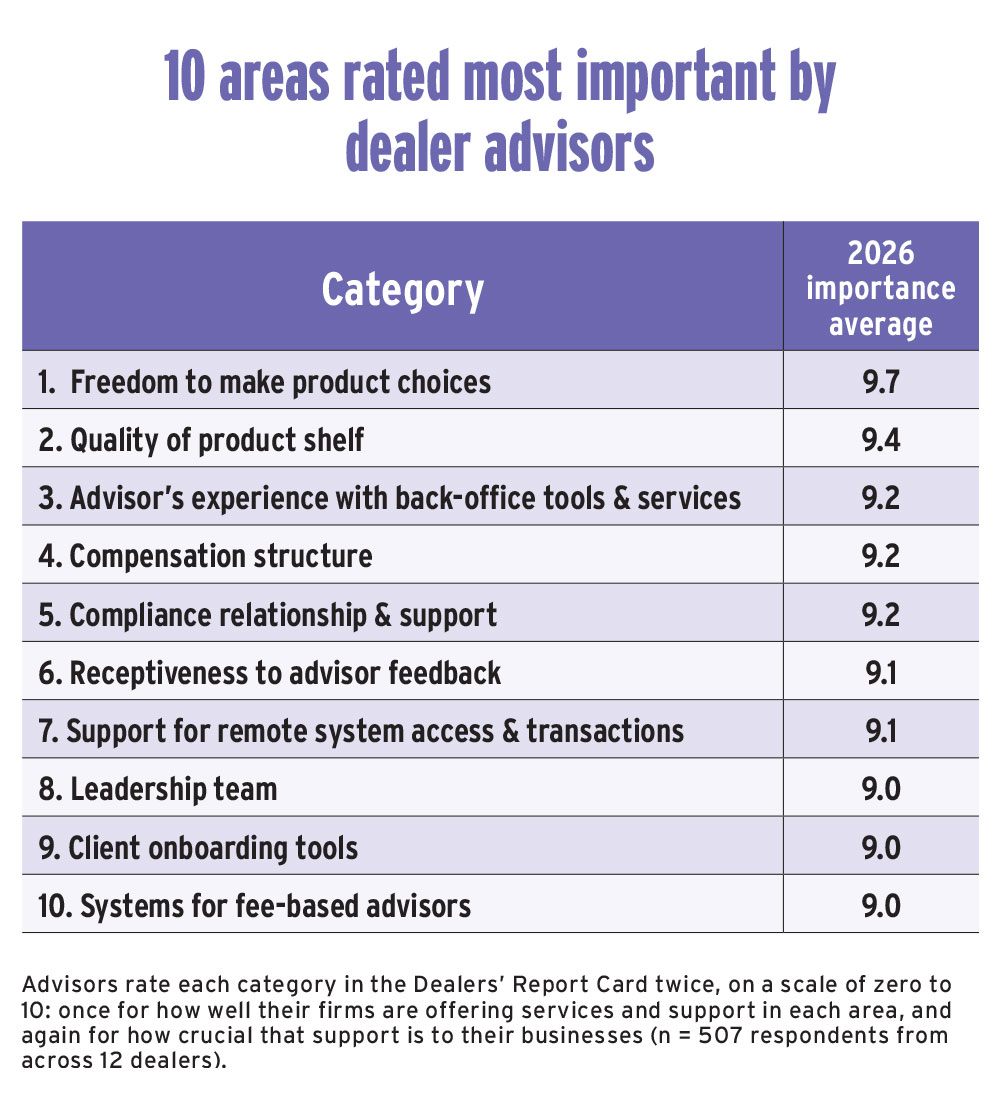
It’s important that dealer firms pay attention to the types of support advisors care about. The 10 categories that these dealer advisors prioritized most for 2026 were as follows.
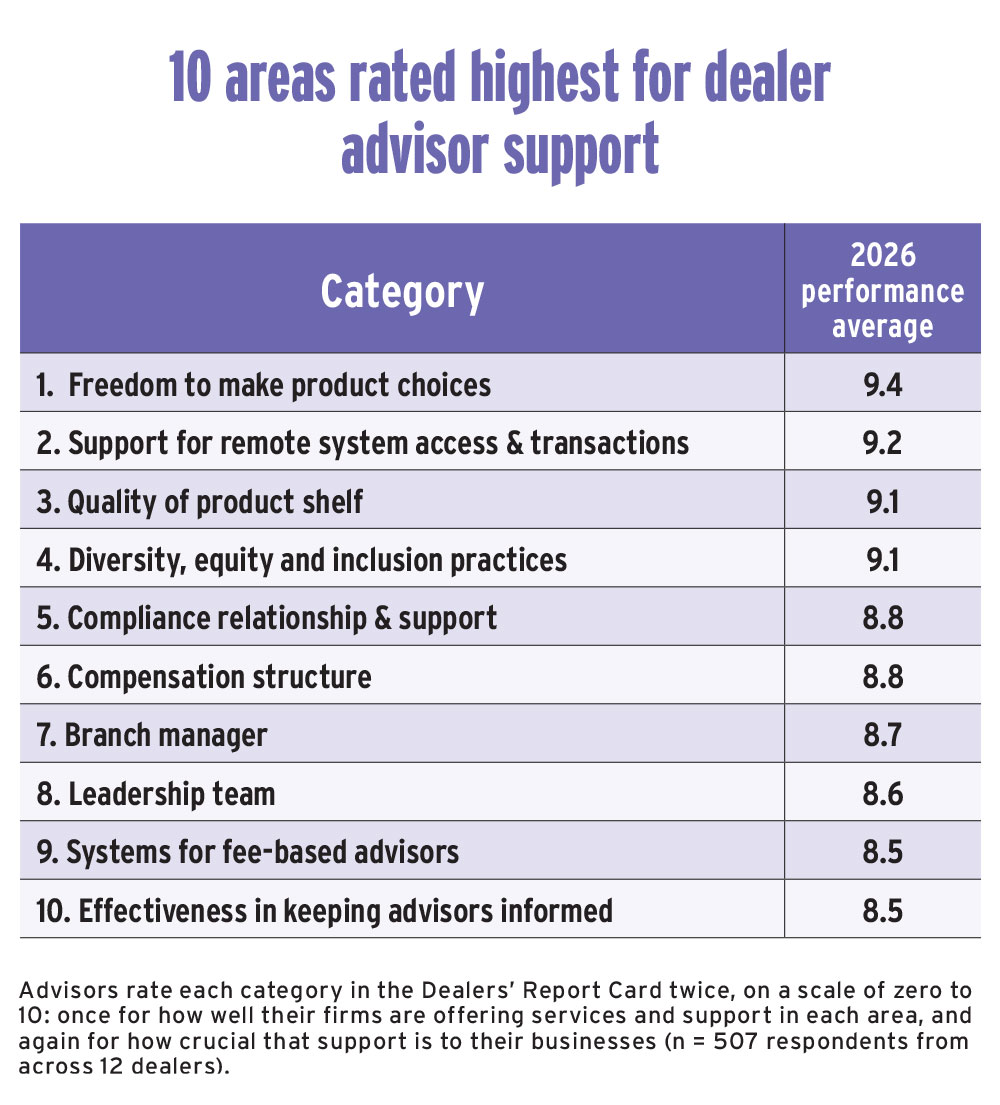
The 10 categories with the highest benchmark performance averages were as follows. This list takes into account the results tallied across the 12 dealer firms, with advisors reflecting on how well their firms are serving them.
In the video included at the top of this post (lightly edited transcript is included below), IE‘s editorial director Kevin Press interviews research manager Katie Keir about the key themes in this year’s Dealers’ report. Check it out!
VIDEO TRANSCRIPT
OPENING: My name is Kevin Press. I’m editorial director of Investment Executive (IE). I’m joined today by Katie Keir, our research director, [who] runs our Report Card series. We’re going to talk about the Dealer’s Report Card today. Thirteen firms. Tell us who you spoke with.
KATIE: Yes. So, the Dealer’s Report Card is very dynamic. It is composed of thirteen firms. We’ve been doing this Report Card for almost 20 years and it includes this year almost 550 [advisors], so across those 13 firms.
And it is similar to the Brokerage but different. The Brokerage [Report Card] is investment dealer only. This one, again, is that mixed operation [group], some mutual fund-only firms.
But in terms of their similarities, you know, these are advisors who have close relationships with clients. They are planning. They have been in the industry more than 20 years on average; with their firms more than 10 years on average.
And I should say it used to be eleven firms. Thirteen now because we added Designed Wealth Management. So Designed was founded in 2021. We also added Sun Life Financial, obviously a big player in the industry. It [the report] includes both their mutual fund arm and their new securities arm, which is emerging and it’s a part of the business they want to grow. And so, we want to capture that growth.
KEVIN: You mentioned a little bit about the similarities between them. What are the big differences?
KATIE: Yeah. So, this report, as I sort of mentioned, it’s organizations of all sizes. So I think, you know, we don’t base this research on revenue, earnings, and market share. That’s not how these firms are chosen and included.
What we’re looking at are the types of services they’re offering. And size is one difference between them. So again, they have advisors who have these relationships, own their books, have been in the industry a while. But what their firms are offering does differ. And so in the table for this Report Card, you do see N/A is one tag that we use, [meaning] not applicable.
So, we’ll sort of get to this later in the conversation. Under wealth management, business coaching, these are services that not every firm offers. We’re talking, you know, pay is core to the service, infrastructure, back office, compliance. But when it comes to some of those more nuanced services, that’s where you are going to see some difference between them [the firms] and some difference between the groups of advisors.
And in terms of size of advisor, they’re managing $93 million on average in assets. They have close to two hundred client households. Again, there is variance there. So, if you’re looking across the firms, some of the smaller firms by number of advisors (again, not by market share), they may not have some advisors who are managing $93 million, $100 million, many hundreds of millions.
Some of the larger firms that you’re going to see, some of those, you know, Sun Life Financial is a very large firm.
You’re going to see some advisors who have been building quite a large business over decades.
KEVIN: How’s the segment doing generally?
KATIE: Yeah. So really good question. The dealer space, sort of like I mentioned, is one of the most interesting to watch. This is partially due to those differences that we see between the firms, some of the similarities, some of the nuances.
But partially because we’re just seeing a lot of movement in terms of their infrastructure [and] their tech, tech transformation is massive in this space. We have some firms that are dealing with legacy tech, legacy infrastructure, and they’re trying to move toward more streamlining [and] easier processes for clients and advisors. So that’s been huge. Also, M&A and recruitment activity; that’s been a big driver as well.
So, we’ve seen some big deals in the past two, three years. Desjardins Group bought Worldsource Wealth, which sort of speaks to that adjustment that I spoke to earlier. IPC and Canada Life have aligned. They’re under the same ultimate parent company, but they have aligned and that is leading to some reorganization between them.
We also have Assante. Assante[‘s parent company CI Financial Corp.] had their privatization deal with Mubadala Capital. So, you know, that is another change.
And, you know, in terms of how they’re [all the firms are] doing IE rating-wise, I would say there’s actually relative stability.
If we look at the ratings, advisors, how they feel about their support, the IE ratings are generally solid (eight and above); very respectable. These advisors do tend to understand that a lot of this transformation is a process. As long as they’re communicated with, they know that and they appreciate what their firms are doing and appreciate the changes.
However, change is hard, change is happening. So, yeah, it’s a bit of a mix.
KEVIN: And leadership changes too, right, as so often happens with M&A activity?
KATIE: Yeah. So outside of some of those bigger deals that I mentioned, [there’s] Manulife Wealth. Brett Marchand took over for Richard McIntyre just in April. So that is a change that actually happened while we were in field with their advisors. We also had, at Sun Life (and this is not as new of course) Reggie Alvarez joined as president of their mutual fund side roughly two years ago. And so, as we often see in the data, that is a change that continues to manifest. We ask advisors to not just think about today, not just think about how I felt this afternoon, but to think about what the past year has been like. And when you have these leadership changes, whether new or medium-term, that sort of impacts how advisors feel — how they feel about stability, strategy, where the firm is going, and just who is taking their feedback.
KEVIN: And Richard’s gone to Harbourfront [Wealth Management Inc.], we should say.
KATIE: Yes, that’s right.
KEVIN: Talk about how all of this change impacts dealer firm operations.
KATIE: Yeah. So, I think generally speaking we talk about this with leaders at the firms. And, you know, I think anybody in the business understands that merger and acquisition, advisor recruitment activity [and] even tech change, this is all often done with purpose and with deep research, [and] with getting advisor feedback. You know, when you do deals like this, when you have change like this, it’s partly for scaling out, it’s partly for gaining capital if it’s a private equity deal, it’s partially just innovating, like we said, legacy technology. But it takes significant investment, it takes significant time. And so, a lot of this is done over a long period of time.
So, I know some of the deals that we talked about (Worldsource-Desjardins, IPC-Canada Life), these are three years gone now almost. But they’re really still happening in real time.
And so it impacts firms’ operations piece by piece, it impacts branding exercises, reorganizations. You know, we see a lot of this manifesting slowly. And that’s why in our datasets, we often have advisors still commenting three years later about the new leader.
KEVIN: And of course it impacts advisors. What are we hearing from them amidst all this change?
KATIE: Yeah. So, we asked a question about this because the fact that firms change, evolve is not new, but there’s a lot of conversation around it. There’s a lot of conversation around recruitment. So we asked advisors: how do you feel about this? Does it impact your business? Does it not? How do you think about it? Are you comfortable?
And so, we gave them a few options. They could be excited, interested, concerned, don’t care, it’s just noise. And so, a bit of a split; not surprising in the Dealer’s Report Card — 36.6% said it’s just noise, I’m not paying attention. They care about their clients. Makes sense.
But almost as many (32.5%) said they were either excited by or interested in this sort of activity, this adjustment. It [M&A activity] is a disruption, in some cases. If it’s external of course, it’s just interesting.
But what we heard from them [advisors] a lot is they want their firms to compete; they want their firms to be innovative; they want their firms to be leading edge. And so for that to happen, this disruption has to happen. Industry movement has to happen. And they want variance in the industry. They want competition in the industry. You know, there’s a camp of people who don’t pay attention, like we said, [and] a camp of people who are interested by the opportunities that this brings. And then there’s also a camp of people, I should say, or pockets of people who shared really real concerns. Their firm has a specific culture, has a specific way of working. They have a way of working. And so, some people [advisors] are concerned about that changing too much.
And so, I think it’s there’s not one way is the short answer. It’s really a balance between yes, let’s have change but let’s still have industry variety, let’s still have some industry stability.
KEVIN: Technology is an interesting topic because there’s this consistent gap between advisor expectations and what the firms are focused on and what they’re delivering. And this is cross-channel. What did we learn in the Dealers’ report?
KATIE: So, yeah, we talked about this even for the Brokerage Report Card.
And I mentioned this report itself has existed for 20-plus years and this [tech pain points] has been a mainstay, a persistent topic. Tech glitches, inefficiencies, that’s never good for business. Not for the advisor in front of the client, not for the business itself. And the leaders know this. The advisors know this.
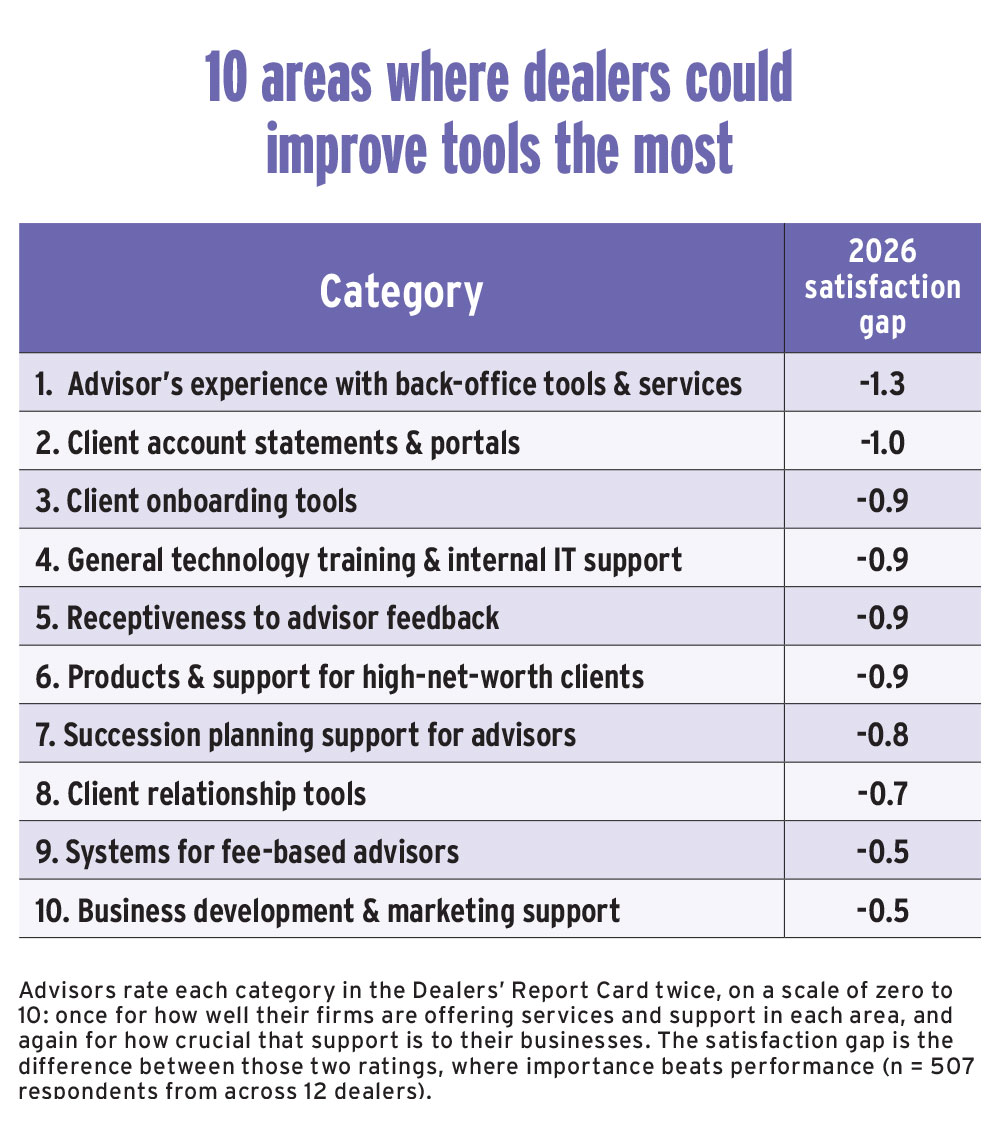
When you look at where the dealers are weakest in terms of the 2026 performance averages or when you look at the gaps between where the advisor importance averages [are higher] versus the performance average, it’s technology. That’s what shows up in those lists. Client onboarding, client tools, dashboards, client account statements, technology training; These are all things where there’s friction.
The advisors know this; the leaders know this. So, we’re not telling them anything new. What’s perhaps tough in this particular segment is the independent spirit of a lot of these advisors runs somewhat contrary to some of the things they want the firm to achieve. So, you know, if I’m an advisor who wants to use all the same tools I’ve been using for years, I’m not necessarily against technology but I don’t want to change what I’m doing. I don’t want to completely shift my business. That can be tough for some of these dealers, and we’ve had conversations with leaders where they said, ‘We’ve pushed the pin so far and now we need the advisor to also get on board with us.’ The advisor adoption rate. You’re not going to invest more in something that advisors aren’t using.
So, I think that’s really for this particular report what drives a lot of that friction is respecting that independence, respecting that freedom, but also perhaps looking at where is that causing issues. And do you have to at some point institute specific tools that advisors have to use for data privacy, data security, streamlining. And again, where those come together is a challenge.
KEVIN: And this is all made more complicated by artificial intelligence and its profound effect on the business.
KATIE: Yeah. So, we also asked a question about AI, similar to the Brokerage [report]. We did have different results here [than in the last report]. So, very simple question. Do you understand your firm’s policies around the use of AI, around the software they’re providing, that kind of thing. So, 57% of advisors said yes, I understand the policies. That’s a good number, it’s the majority.
[In comparison], 37.5%, 38% said no. They were uncertain about the tools, the policies, how they were supposed to integrate this or how it would impact the business. And then the rest of the people just said I don’t even understand AI.
Now this was contrary to the Brokerage because in that space we saw 80%, like, the vast majority of the advisors said, yes, I understand what my business wants out of this, I understand where they’re going [with AI]. And this isn’t necessarily surprising because, similar to the other results that we had in this [Dealer] report, we have a camp of people who are very excited about it, want to use it, know where the business is going with it. Some of the larger businesses, just by scale, have a little more power here in terms of advisor adoption and investment. But all of the firms, regardless of size, are looking at AI. And yeah, advisors and leaders alike share privacy concerns, regulatory concerns, even scaling concerns. As AI power needs advance, so too do the dollars around it.
So yeah, there’s just a lot of conversation around what makes sense.
KEVIN: Yeah, there’s so much to it and still so much that we don’t know. Where are advisors looking for more support?
KATIE: Yeah, so we have a couple areas where this is happening. The first we’ll touch on is business coaching, business skills. Business skills and development is sort of the subgroup tag that we have on this. And so, ten years ago, this was an area where (you know, I’m talking 2016, 2017, 2018, around there) only half of the firms in the Report Card actually had ratings here. They were often [marked as] not applicable; didn’t really do that and the advisors only wanted back office, compliance, pay, the basics.
Now though, that is changing. We actually have the majority of the firms that are being rated in this area. Now, it’s still an area where advisors [are] independent, free thinkers. They may not need the coaching. But it is an area where we’re seeing more firms say, ‘Yes, we know we need this. We need succession, we need business coaching. We need just growth/marketing support tools, especially for younger advisors coming in.’ If there’s any firm that’s trying to drive down the advisor age.
But yeah, that’s an area. Social media [use by advisors], I’d say, is the one piece where it’s interesting to watch. It’s very, very slow but we do see more firms, you know, trying to find third-party partners. Trying to look at supporting this because, you know, I could be an advisor who doesn’t know how to [produce] a podcast or film a video or post online, and it’s useful for me to learn that skill if I ask for it. But it’s a love/hate relationship. So, yeah, that’s one area.
KEVIN: Different story with wealth management tools.
KATIE: Yes. So, wealth management tools [are] very similar, very intriguing. Again, ten years ago, if you look back at those tables — now they were organized differently so you kind of have to look for the different [wealth-planning] pieces — but financial planning support, support for high-net-worth, wills and estate [planning], insurance; all of these things are extremely important to clients or at least are becoming so. As people are aging, as people are retiring, they’ve always been important. But complex planning is becoming more of a skill that is really good to have [for advisors]. And so again, there are firms where they may have it baked in. There are some of the larger firms have a lot of this stuff built. They have private wealth arms, they have more of that ability within the business. There are firms that have to partner elsewhere. You know, we’re talking [firms partnering with] Willful, ClearEstate, things like that.
Conquest is a big financial planning partner. So, whether it’s third-party partners or internal, I would say it’s an area where the firms are looking to invest more, wanting to invest more. But still an area where there is that decision to be made: do you guide the advisor there or not?
And in terms of stats, the reason it’s important is unsurprisingly nine in ten advisors in this dataset are doing financial planning. How complex that gets depends on the resources they have, the industry connections they have. Fifty-eight per cent of their clients have full plans. That’s what they say, that’s what they reported. Now that’s up from 75% of people [advisors] doing planning ten years ago. And interestingly, the number, the percentage of plans, was 56% a decade ago. So, the number of clients who have plans isn’t changing that much but the number of advisors who are interested in financial planning and having to move that way is increasing.
And so by that virtue, you think it makes sense that the firms would want to as well. Just again, how much do we respect that advisor choice, flexibility, freedom? Or how much do we prescribe a tool?
KEVIN: Anything that we haven’t covered yet?
KATIE: Yeah. I think we talked about it, but there’s probably two things that come up in this data that are [interesting]. I wouldn’t say our data is super in-depth [on these] at the moment, but it’s interesting. So, advisor teams. And when we talk about advisor teams, we’re talking advisors who have teams with another advisor. So, either co-owning a book or they partnered in some way, they both own their own book. Advisors might have admin assistants, they might have junior staff, but we’re talking teams of mature advisors banding together. Or, you know, a mentor-mentee.
It’s very low in this space, remains very low. Only about a third/just over one-third (37% of these advisors) say they’re on a team with another advisor. So that leaves 60%-plus who are working on their own, reportedly. Now I know that some of these advisors say that they have informal relationships — they’ll work [together] within an office or just have friends in the industry where they say, you know, if something happens to me, I’ll lean on you.
There are informal partnerships. But what that brings up is sort of that succession business question again of how much are these advisors doing that and taking that initiative? How many of them have succession plans?
And we ask that: 40% say they have a plan, but that leaves 60% that don’t. Twenty-five per cent of that 60% are working on it. So that’s positive. But it still leads to that question of how much are we going to see that area evolve?
And then the only other thing I’d mention is something we’re seeing in the dataset. So, we mentioned Manulife, we mentioned Sun Life, we mentioned Canada Life. These are typically companies that have been seen as very strong brands as insurance companies in Canada.
Now Sun Life has come out saying they want to build that wealth reputation. Canada Life, you know, they’ve had wealth ability but [with] their sister company IPC, they’ve partnered more strongly in the past few years [and] so they’re building that wealth profile. Manulife Wealth had a rebranding exercise several years back to boost that as well. You know, they’re more than just an insurance company and I think we’ve heard that said by some of these companies.
And so how does that look in five years, ten years? You know, we hear a lot about the banks [and about] how much they eat assets in Canada. But what does this look like? And how do the independent firms or the so-called independent firms feel about these [insurance] players? And I don’t know the answer to that. But it’s interesting.
KEVIN: We’ll keep listening. It’s something they’ve been dealing with for years. Right? Katie, thank you so much.
KATIE: Yeah. Thank you.
KEVIN: Great work. Terrific work. And thank you for watching.
KATIE: Yeah. And you can read the full Dealer’s Report Card at Investmentexecutive.com [on] Sept. 15th.