

Research for the 2026 Dealers’ Report Card by Investment Executive (IE) was conducted by seven research journalists: Rosa Beig, Roland Inacay, Filip Kovacevic, Diane Lalonde, Ciara Lalor-Lindo, Alisha Mughal and Noah Trenton. These researchers spoke with 542 advisors across Canada from 13 full-service or mutual fund-only firms.
Data was predominantly collected via telephone interviews with the advisors, between March 3 and April 30. All respondents were registered, full-time advisors who, at minimum, had their mutual fund licence. They’d worked with their firm for at least one year and had worked in the industry for at least three.
This year’s report includes two new firms to the project: Designed Wealth Management and Sun Life. Advisors with Desjardins Financial Security Investments or DFSIN were also polled and are included in our demographic and thematic analyses, but their firm doesn’t appear in the firm-by-firm results as DFSIN is no longer a separate registered entity — those advisors are now registered under Worldsource Wealth Management, even though the DFSIN brand remains.
Advisor participants provided two ratings each for their firms’ support systems and services, across 25 categories: one rating for performance, considering how well their firm has helped them run their business and serve clients; and the other for importance, sharing how crucial each category or support area was to them personally.
Both ratings were on a scale of zero to 10 — a rating of zero means “very poor” or “unimportant,” while a rating of 10 signifies “excellent” or “critically important.” Advisors were asked to provide ratings only for services and systems they had used directly. No category names in 2026 were changed, and no categories were removed or added compared with the 2025 report. (See the main results table.)
A firm is marked not applicable (N/A) in categories where it doesn’t provide formal tools or support. A firm is marked non-calculable (N/C) in a category if too few advisors were familiar enough with their firm’s tools or support to rate it fairly.
For each firm, advisor ratings are aggregated into average results across 25 categories. A significant change requires a shift by half a point or more in a firm’s category rating compared with the previous year. This applies to: firms’ IE ratings, the average of all of a company’s category ratings; and the collective 2026 performance and importance benchmark averages (these tally all the firms’ ratings by advisors in each category). The performance average benchmarks firms’ individual ratings, while the importance average indicates how important the average dealer advisor feels a category is to their business and work.
The satisfaction gap or surplus is defined as the difference between a category’s overall performance and importance benchmark averages.
The Report Card series isn’t an awards program or contest, and it isn’t a ranking exercise. It doesn’t base inclusion or results on sales activity, revenue or assets. The project is editorial-driven research that aggregates opinion- and experience-based data, using a rigorous methodology.
Advisors were asked four supplemental questions in 2026, alongside anonymous questions about their business details:
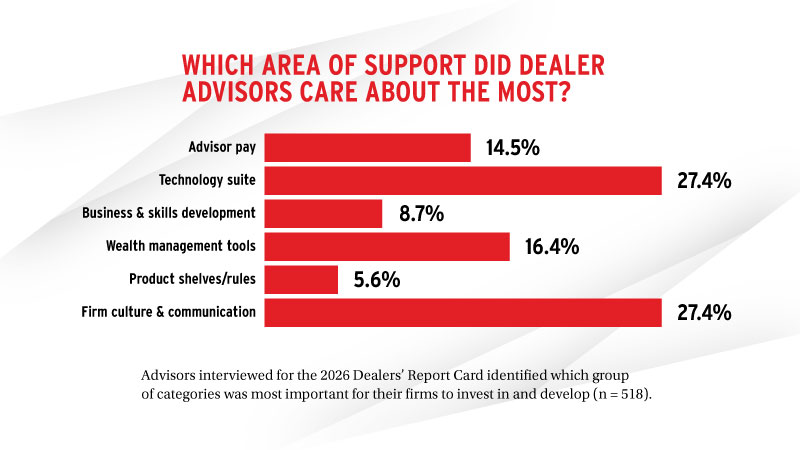
1) Out of the six groups of categories included in the Report Card, which group is most important to you personally when it comes to where your firm should focus and invest?
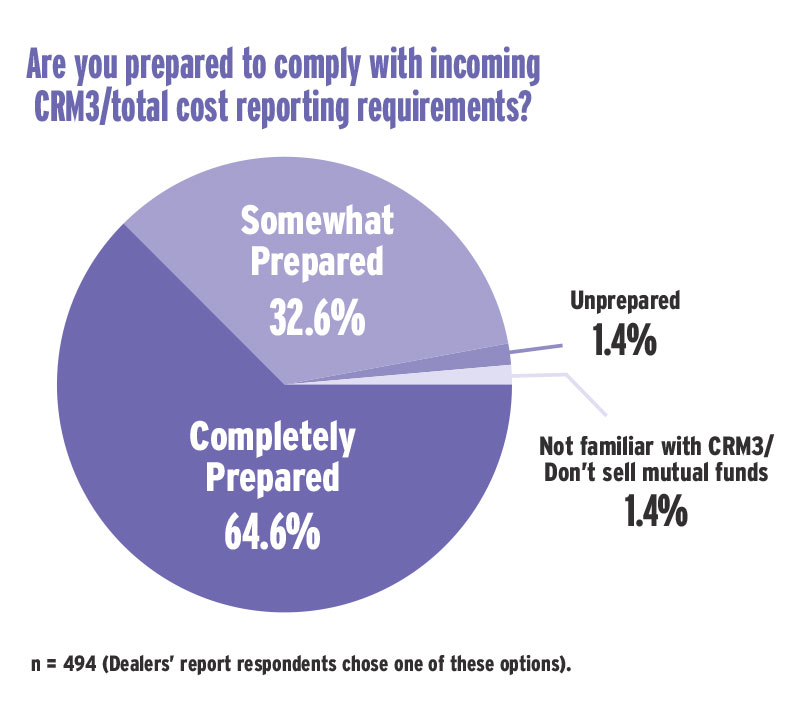
2) How prepared do you feel to comply with total cost reporting/CRM3 requirements, which may lead to additional fee discussions with clients?
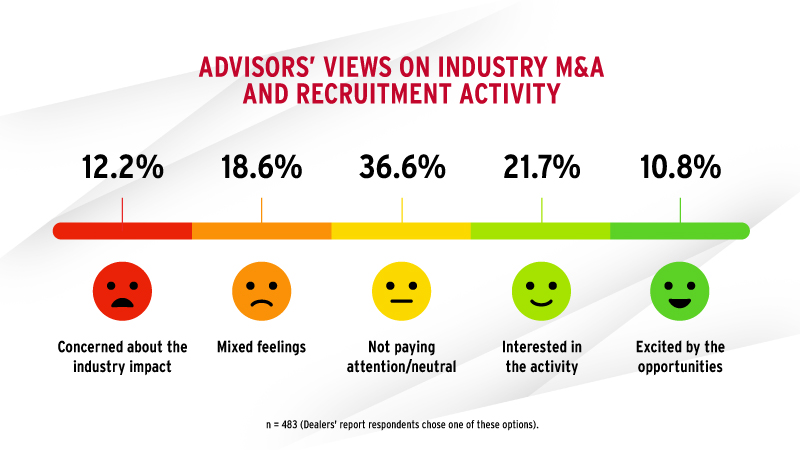
3) Which statement best illustrates how you feel about industry merger-and-acquisition activity and increased advisor recruitment activity? (The five options ranged from concerned about it to excited about the opportunities.)
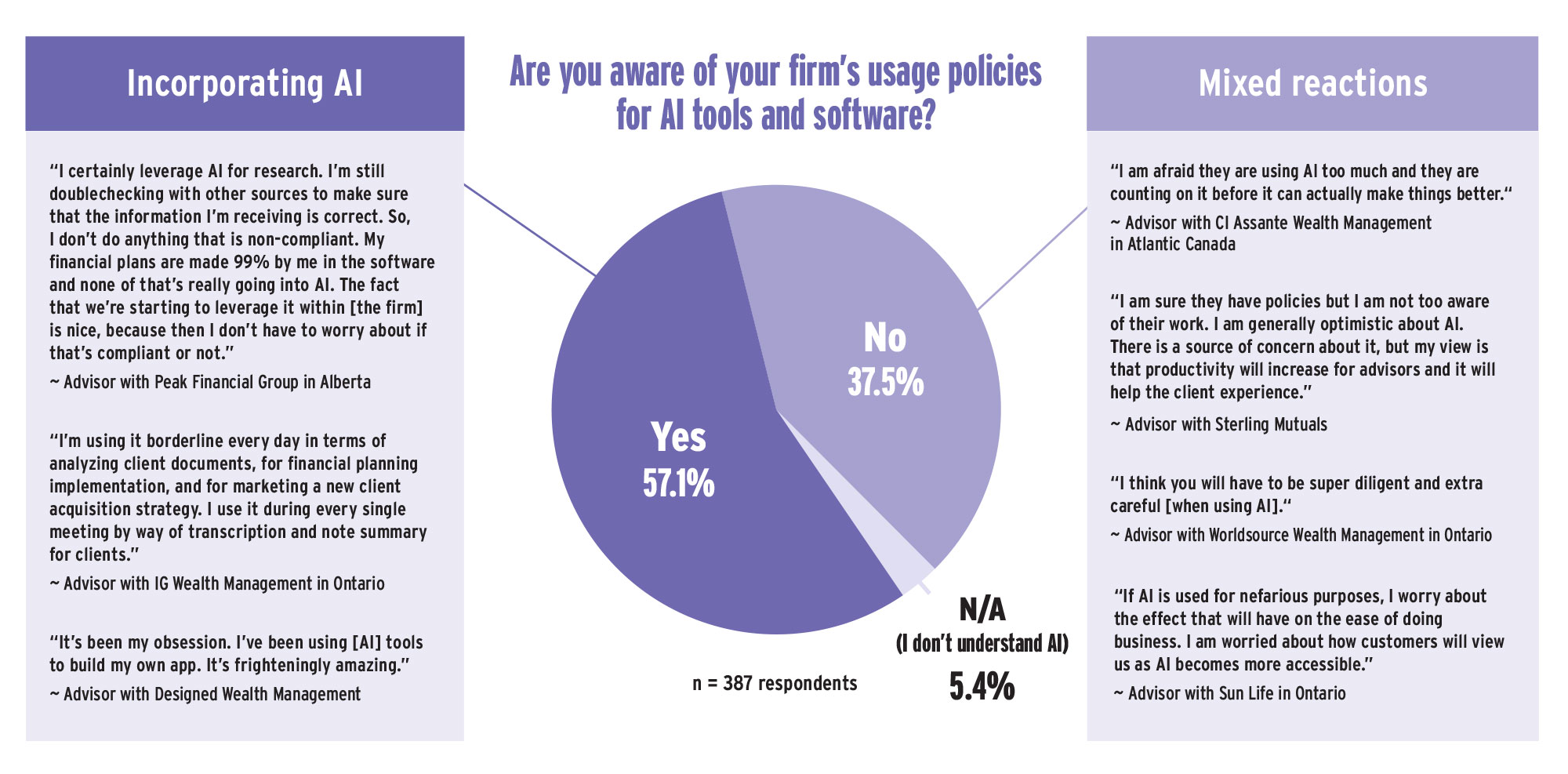
4) Are you aware of your firm’s policies and strategies around the use of AI-powered tools and software?