
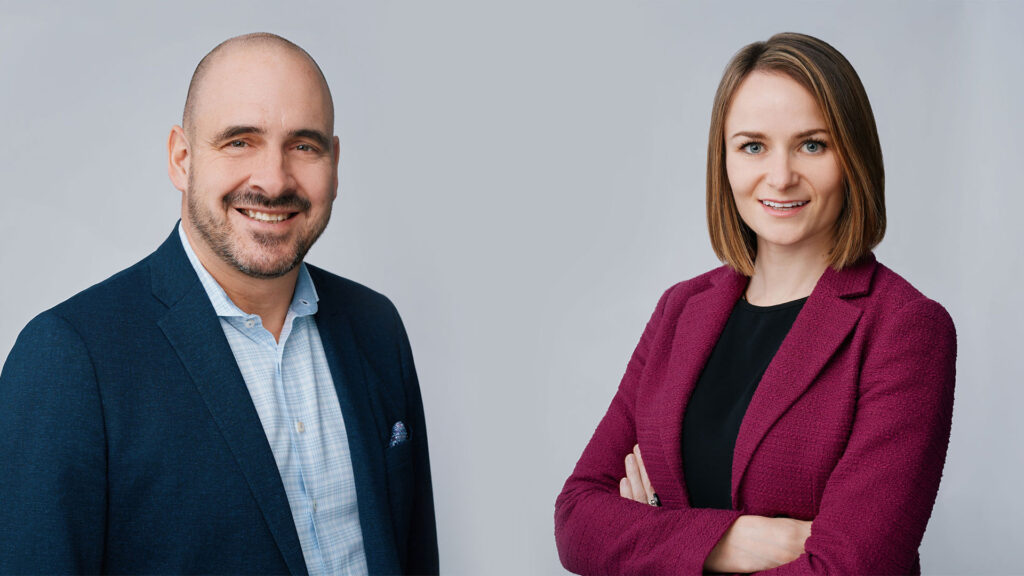
Designed Securities Ltd. has passed its first test: five years after launching, it’s grown to 175 advisors and is on track to reach $10 billion in assets under management (AUM) by the end of the year. It’s now turning a small profit.
But the way co-founders Michael Konopaski and Gillian Kunza see it, that’s just the beginning. In another five years, they believe they’ll reach $100 billion in AUM.
It’s an audacious goal for the upstart dealer, which just three years ago was struggling with just 35 advisors and in Konopaski’s words, “no pipeline.”
The pair, who were previously executives with Aligned Capital Partners, don’t see it as out of reach.
“If we keep growing based on the types of decisions that we’re making, ten times bigger doesn’t seem that tough,” said Kunza, CEO and chief compliance officer. “I don’t see why we wouldn’t hit that type of milestone.”
The firm, which operates as Designed Wealth Management, is making its first appearance in the Dealers’ Report Card this year (access the main data table, showing all firms’ results and our firm-by-firm guide). Up to now, the young dealer has targeted advisors in the independent channel, its chief sell being flexibility and customization, as well as a flat-fee model that’s popular with its advisors.
Its founders believe they can continue to meet new growth milestones by leaning into customization. They also plan to widen the net to start targeting bank advisors.
“At some point, an independent dealer hits a saturation point in recruiting independent advisors from independent dealers,” said Konopaski, the firm’s managing director and CFO.
“The blue ocean is in the bank advisor marketplace, where if you can get 1% of the market, it’s massive. it’s probably bigger than the entire independent marketplace.”
It all seems ambitious. Bank advisors, Konopaski acknowledged, are the hardest to recruit since they’re considered to be employees rather than contractors. And Designed still lacks the range of tools, services and capabilities needed to compete for them.
To top it off, the firm doesn’t offer recruiting bonuses. As a result, “19 of 20” advisors they speak with choose not to come over, Konopaski said.
So why are Designed’s co-founders so confident?
Where Designed is now
Konopaski, 54, and Kunza, 41, started Designed in 2021, after leaving Aligned Capital Partners.
At Aligned, the pair got a nuts-and-bolts education in what it takes to run a dealer firm — gaining finance, operational, business development and compliance experience. Both are chartered financial accountants.
Kunza spent eight years with Aligned, serving largely in VP-level roles, before being named chief compliance officer and head of business integrity in 2019.
Konopaski’s industry experience goes back further, including 20 years as an advisor. He was CFO of Money Managers Inc., which was started by his father Frank and subsequently acquired by Aligned Capital Distribution in 2012. Michael kept that role after that acquisition.
According to the duo, they each brings complementary approaches and opposing strengths to the partnership.
Kunza is more execution- and process-oriented — “more of a CEO,” Konopaski said. She’s also better at evaluating new platforms and technologies and their impact on the advisor experience, he said.
Konopaski is the “builder,” bringing a keen sense of strategy, comfort with risk and moving at a faster pace, according to Kunza.
Typically, Konopaski will come up with an idea, based on conversations with advisors, and bring it to Kunza. A great idea isn’t enough, though.
“She would want to quantify that. She would want to see a cost model. She would want to see estimates” — basically, proof that “this is a good deal, it’s not just my hype and my intuition.”
Ultimately, the natural tension between their approaches ends in a better decision-making process, Kunza said, where each covers off the other’s blind spots.
“A lot of times, two people think the same way and they get along great, and that’s why they decided to be a partnership,” Kunza said. “I think when you have disagreement and you have dissension within a partnership, that is what creates better thinking.”
From the beginning, their core strategy for Designed has been to provide advisors with compliance help, finance and operations support, and access to custody trading and settlement and supervision — “regardless of their style of practice,” Konopaski said.
The firm has grown quickly, especially with younger advisors (35 to 50 years) in the independent channel who are looking for a platform rather than a “payout,” Konopaski said. The dealer has found success with family practices that aren’t looking to sell their business and advisors outside of the big centres, as well as in Toronto.
While the firm doesn’t offer as many planning tools as more established dealers, Kunza said, the upside of starting a firm from scratch is the leadership can be responsive to what advisors want.
“We think like a younger organization,” she said. “We don’t have a lot of legacy thinking, legacy systems,” or an old guard that’s unwilling to work outside of a prescribed comfort zone.
“It doesn’t always mean we do everything or customize every single ask. But we’ll learn from the advisor what their needs are, as opposed to imposing on them what they are required to do,” Kunza said.
Konopaski adds that because the firm is so new, it started off with modern technology, workflows and digital platforms. That means it can focus on innovation and improvement rather than repairing old systems, he added.
He also credits the firm’s governance structure as allowing it to be nimbler, as decisions can be made without having to go through as many layers of approvals.
A third factor is the emergence of AI functionalities, which is making it possible to grow faster. The firm routinely looks for processes where it makes sense to use AI, said Kunza.
For example, a compliance process like a website review, which involves searching for the same things each time, can be scripted into AI. That allows compliance personnel to “spend a bit more time on judgment as opposed to spending an hour just figuring out if there’s anything there to judge,” she said.
The firm is adding new portals, improving its systems and investing in AI and automation, while also prioritizing in-person socials as a culture-builder.
What advisors said
The 30 Designed advisors who participated in this year’s Report Card aren’t industry newbies. On average, they have 21.9 years of industry experience and have been with the firm for three to five years.
According to this year’s research, they’re happy. They gave Designed high ratings — the dealer outperformed the performance average benchmark ratings in the 16 of 25 categories in which it could be rated.
Designed Wealth advisors were particularly pleased with the firm’s compensation model, their ability to make product choices, and its culture and leadership responsiveness.
“[Designed is] a company that says, ‘Yes, how,’ not ‘No, because,’” said an advisor with the firm.
Another advisor with the dealer said, “They have been so incredible. They live behind their mantra of being there for their advisors.”
Advisors also praised the firm’s flat fee structure, which was a model borrowed from Aligned.
“When I add new clients to the mix, I know how much additional revenue I’m adding,” said another of the dealer’s advisors. This same advisor praised the firm’s back-office support and said, “I love coming to work and my book just keeps doubling.”
The fee applies no matter the size of an advisor’s book.
“We got very good at making money on that model,” Konopaski said. Designed’s flat fee, which will be adjusted for inflation going forward, runs around $3,150 a month for investment advisors and $2,100 a month for mutual fund advisors, and accounts for about 35–40% of the firm’s revenue, Konopaski said.
The fee model isn’t just popular; it’s integral to the firm’s culture, he added.
“You can’t slam your fist and say, ‘You know how much money I’m making your company?’” Konopaski said. With $200-million and $40-million advisors in the same registration category paying the same fees, “there’s not a culture of prima donnas.”
Every advisor has a relationship manager they can turn to when they need something — which Konopaski noted is “a very expensive business model” but one that advisors prize.
Growing pains
While advisors gave Designed Wealth generally high marks, they also noted there’s room for improvement in technology, tools and support.
The firm received a non-calculable (N/C) or not applicable (N/A) rating in nine categories, or 36% of the total. That points to some gaps: either tools and resources that advisors aren’t using or aware of (N/C; five categories), or current deficiencies — resources that the firm doesn’t yet offer (N/A; four categories). These gaps can be seen in wealth management and business & skills development tools and support.
Some advisors also alluded to growing pains amid the firm’s rapid growth, affecting back-end systems and procedures, or the need for the dealer to add to the management team or back-office staff training.
“Some of their systems and procedures are being designed as we go,” said one of the dealer’s advisors.
“Have more of the support [staff] have experience in working with clients,” said another advisor. “They all seem to [be] green.” This same advisor noted that “the leadership has experience in the industry, but not as a leader.” They question what might happen when major growth challenges arise.
Another note of caution in interpreting the firm’s results is its own newness. With all its advisors having five years of experience or less with the firm, it’s fair to ask if there’s a honeymoon effect that may fade in time.
Konopaski acknowledged that the firm’s ratings could fall in future. (Designed was not informed of ratings before publication.) His greatest worry is that at some point, an advisor will say to him, “It’s just not the same.”
But he believes the firm will avoid that fate. Konopaski and Kunza have signalled from the start that they’re not for sale, which is what they believe leads owners to cut back on investing in their platform.
“That’s when you lose your culture,” Konopaski said. “We really have no vision for an exit … we feel like we can carry it on indefinitely.”
Scale through customization
For its next phase of growth, Designed plans to double down on customization.
The firm is already dual-registered and registered as an investment fund manager, which allows portfolio managers to sub-advise their own pooled funds. It’s registered in the United States as an investment advisor. It’s building a unified managed account platform and a capital markets group. And in what might be a first for a CIRO-regulated dealer, it’s adding a second custodian, National Bank Independent Network (it currently uses Aviso Correspondent Partners), to give advisors more choice.
Everything the firm introduces is in response to advisor demand, Konopaski said.
Some of its advisors are already asking about things like private banking — something they’ll need if they want to make a play for bank-brokerage advisors.
“We actually can’t go after that market with our current business model,” Konopaski said.
As Designed continues to add new features, it expects to keep costs down by collaborating with other firms, including competitors, to get advisors access to things it wouldn’t otherwise be able to afford.
The firm generally eschews enterprise licences for technology to keep costs low and preserve advisor choice. But Konopaski sees the firm introducing a turnkey asset management platform for advisors who are entrepreneurial, but not yet in the independent channel.
“We have enough demand where, 18 months to two years from now, you’re likely to see two models,” he said. “One is the current model, and another is more geared to a bank advisor who doesn’t want to think about the research tools, they don’t want to think about the CRM or their portfolio rebalancing platform. They just kind of want to be handed something great that all fits together already.”
He also expects a pivot away from Designed’s branding to date, which has leaned heavily on establishing its credentials as an “independent” firm.
“Bank advisors don’t care. They want safety and security, right?” Konopaski said. “So you have to be careful. At first, it’s kind of like us versus the bank, but now it’s like we want people to think they’re sort of at a bank.”
Asked whether the level of customization they’re planning could become unwieldy and hard to manage, Kunza said not the way Designed is doing it.
“A lot of people see customized as you’re all over the place, you’re too many things, doing things in too many different ways. Whereas we see customization as an outcome of a scalable process,” she said.
“It comes down to process because if you customize regularly and you have a process to evaluate where you would customize or how you would approach different requests, it’s not all that unique.”
Adding bells and whistles, however, could mean introducing a tiered fee system at some point for concierge services such as private banking, direct indexing and unified management account platforms, Konopaski said.
Culture management
If the firm is successful at adding bank advisors, its ability to maintain the culture Konopaski and Kunza have worked so hard to build is bound to be tested. Konopaski acknowledged as much, that any business model change has the potential to change a culture. Both partners are undaunted.
“The culture is about customization and flexibility, and giving the advisor an opportunity to … [be] self-actualized. That’s why people join us,” Konopaski said. “But if you want to grow your company, you’ll also have to think about enhancing the menu.”
Since the advisors joining so far have wanted to be part of the existing culture, Kunza isn’t worried that a big wave of bank advisors, for example, would change the culture for the worse.
“If you manage the cultural change and you don’t try to put your head in the sand, you don’t have to be sort of worried about it,” she said.
“We don’t want people saying, ‘Well, I like the way it was three years ago.’ … I’d rather people say, ‘Sure, it might have been different three years ago, but I love the way it’s evolved, and I still love the culture.”’