

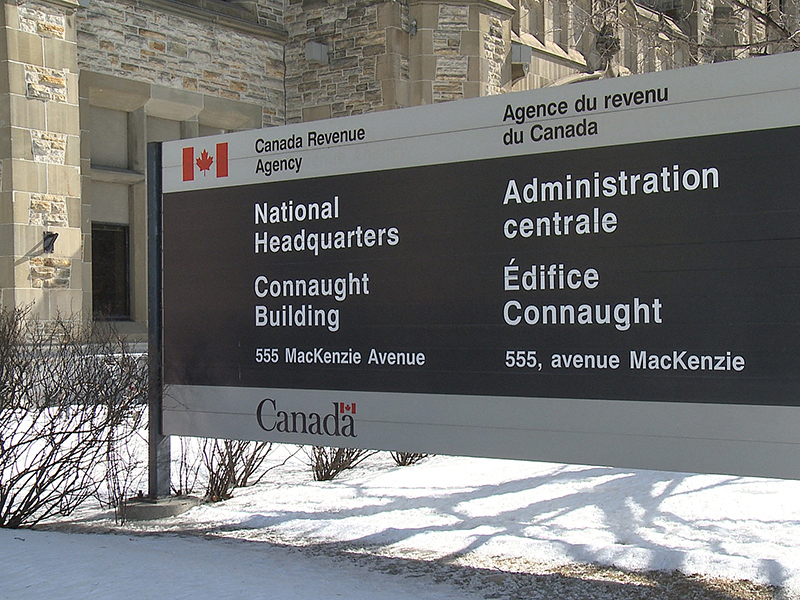
Effective Monday, the Canada Revenue Agency (CRA) is prioritizing requests for advance income tax rulings related to investments of $1 billion or more in Canada, the agency announced.
Corporate taxpayers ask for advance tax rulings, which are binding, to obtain certainty about the tax implications of potential business decisions — before they commit the required capital.
By providing tax certainty, projects can move forward, “creating high-paying careers for Canadian workers, and supporting the government’s broader efforts to attract investment, build major projects and strengthen Canada’s long-term economic competitiveness,” a release from the agency said.
The CRA’s release comes as the two-day Canada Investment Summit opens in Toronto, with Prime Minister Mark Carney aiming to generate $1 trillion in total investment in Canada over the next five years. Canadian and international executives, representing the world’s largest investors — including asset managers, pension fund managers and major resource companies — are slated to attend the event.
Canadian banks, insurers and pension funds have already committed to investing hundreds of billions of dollars in the country over the next few years.
The federal government had announced the prioritization of advance tax rulings for nation-building projects in the spring economic update last April, but no details about the initiative were provided at that time.
Monday’s announcement specifying $1 billion in investment provides an “easily applied metric” for the rulings, said Brian Ernewein, senior advisor, national tax, with KPMG LLP in Ottawa. Ernewein likened the prioritization of advance tax rulings to reducing regulatory burden and reflecting the government’s broader agenda “to be proactive in removing impediments to new investment in Canada.”
Earlier this year, an RBC report on Canada’s lack of capital investment cited existing barriers such as burdensome regulation and a lack of predictability. “Investors are adept at navigating risk but flee when hemmed in by vague rules and shifting frameworks,” it said.
The spring economic update had also said priority will be given to requests for advance tax rulings related to investments that “enhance productivity and strengthen critical sectors,” such as clean economy initiatives.
Questions about CRA capacity, transfer pricing certainty
The federal tax agency said the service standard will remain as is for all advance income tax rulings. “The CRA continues to offer the established 90-business day service standard (or mutually agreed upon service target date) for all rulings requests that do not qualify for prioritized access,” it said in the release.
The 90-business-day service standard, which is counted from when all required information is received by the CRA, was met 91% of the time in fiscal 2024–25, as posted online. However, several months of back-and-forth between a taxpayer and the CRA could pass before the clock starts ticking on the service standard, Ernewein said. And more advance tax rulings could potentially be requested as Canada promotes investment, putting strain on CRA staffing resources.
“To my mind, it is the case that if you’re putting some [requests for advance tax rulings] ahead of others, then you’re putting some behind,” Ernewein said, noting this could be solved with more funding.
Fred O’Riordan, EY Canada’s national leader of tax policy in Ottawa, said he’d like to see new funding or a reallocation of existing resources to the advance tax rulings. Absent either one, there could be a risk of “crowding out other competing advance rulings,” he said. “It’s not as though you need a major injection of funding, but you want to maintain the capacity of that pipeline to deliver.”
As things stand, too many CRA resources are allocated to audits, O’Riordan said, and too few to taxpayer services such as dispute resolution. In the context of trying to attract large-scale capital investments, that allocation mix doesn’t send “a very welcoming, business-friendly signal to these investors,” he added.
The cost of an advance tax ruling is typically recovered from the requesting taxpayer, with the hourly fee currently $306.50 — “a small price to pay for a taxpayer who’s got a significant investment in front of them,” O’Riordan said. But that cost recovery doesn’t address capacity.
Monday’s release didn’t specify that funding has been allocated to the advance tax rulings, and the CRA didn’t provide comment about funding ahead of publication time.
In addition to advance tax rulings, O’Riordan suggested prioritizing advance pricing arrangements (APAs) for multi-national corporate taxpayers that transact between related companies in different countries. For such corporations, a major project could attract a transfer pricing audit.
“There’s got to be some sort of ability to incentivize [investment] in the face of … uncertainty [related to major projects], and an APA is a very good way of doing that,” O’Riordan said. “I’d like to have seen some sort of acknowledgement, recognition around that from the government.”