


Stock pickers — keep scrolling. A new buy-and-hold trend is emerging.
For decades, the 60/40 portfolio was investing’s closest thing to a law of nature. The formula was elegantly simple: 60% stocks for growth, 40% bonds for stability. When stocks stumbled, bonds typically rallied. When bonds lagged, stocks carried the load. The relationship worked so consistently that generations of investors, financial advisors, pension funds and endowments built their portfolios around it.
Then came 2022.
In one of the most painful years for diversified investors in modern history, stocks and bonds fell together. The traditional safety valve failed. Investors who believed they were diversified discovered that owning two assets was not enough.
The problem wasn’t simply that markets had a bad year. The problem was that the foundational assumption behind the 60/40 portfolio broke down.
The model assumes low correlation between stocks and bonds. Historically, that has often been the case. But correlations are not permanent. When inflation surged and interest rates rose rapidly, both asset classes suffered simultaneously. Stocks were pressured by slowing growth and higher discount rates. Bonds were hit by rising yields. Instead of offsetting one another, they amplified each other’s losses.
The lesson is clear: modern portfolios may need a third low-correlation asset. That asset may be gold.
Gold occupies a unique position in the investment universe. Unlike stocks, it is not tied to corporate earnings. Unlike bonds, it is not dependent on interest payments or credit quality. Over long periods, gold has demonstrated remarkably low correlation to both asset classes.
More importantly, gold is one of the few widely accessible investments that can rise during periods of extreme market stress.
Investors often point to defensive equity sectors such as consumer staples, health care or utilities as portfolio stabilizers. These sectors can certainly fall less than the broader market during downturns. But they are still stocks. When panic spreads through markets, they usually decline alongside everything else.
Gold has been different.
During major crises, investors often flock to it precisely because it exists outside the traditional financial system. That makes it one of the few assets capable of delivering positive returns when fear dominates markets.
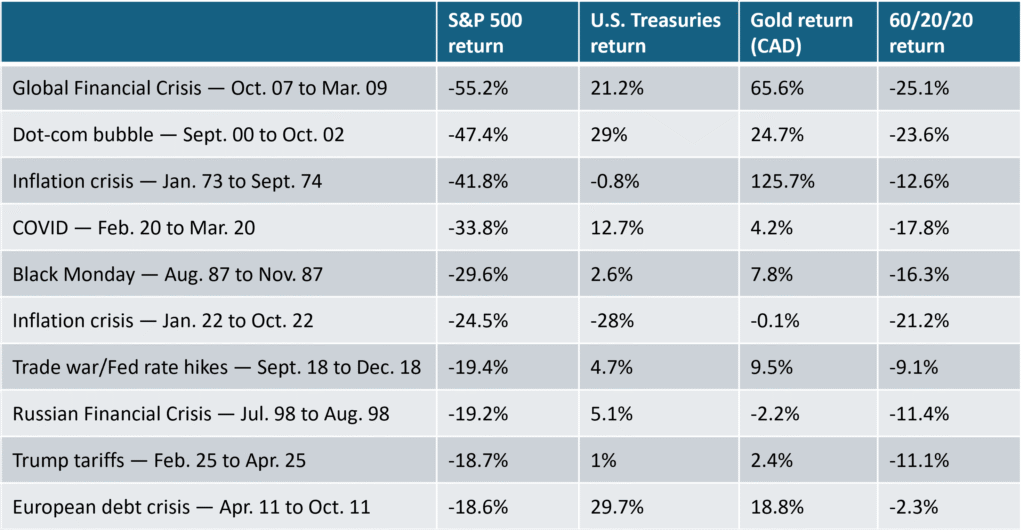
History provides compelling evidence. During the global financial crisis, the S&P 500 fell roughly 55% from peak to trough. During the dot-com collapse, stocks lost nearly half their value.
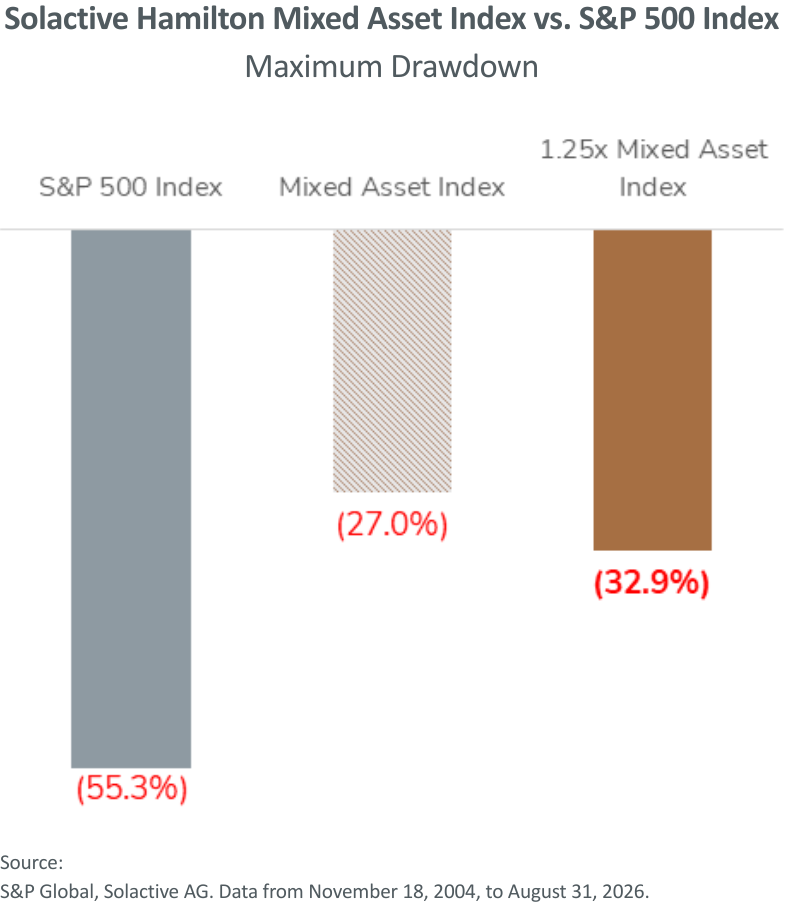
Yet throughout many of the worst equity drawdowns of the past several decades, both Treasury bonds and gold either held their ground or appreciated while equities cratered. This suggests a more resilient portfolio structure may be achieved with 60% stocks, 20% bonds and 20% gold.
The beauty of this allocation is not simply that it can reduce risk. It has historically, without sacrificing long-term returns.
60/20/20
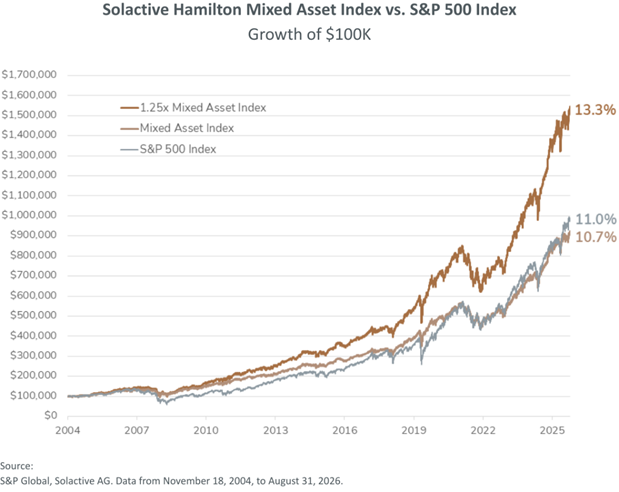
Historical analysis shows that a 60/20/20 portfolio has produced returns comparable to an all-equity portfolio while experiencing dramatically lower volatility.
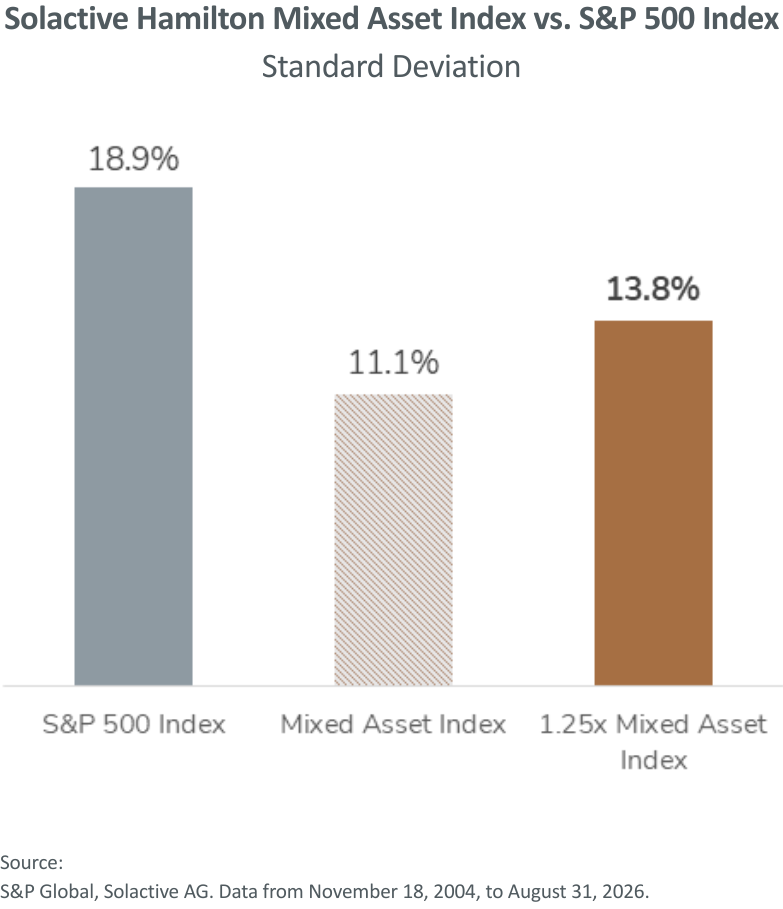
A portfolio invested entirely in stocks has historically exhibited annualized volatility near 19%. By contrast, a 60/20/20 mix has generated similar long-run returns with volatility closer to 14%.
That is an extraordinary trade-off.
In investing, lower risk almost always comes at the expense of lower return. Yet diversification among genuinely uncorrelated assets can occasionally bend that rule. By combining assets that behave differently under different economic conditions, investors can improve the efficiency of their portfolios rather than merely dial risk up or down.
The implications become even more interesting when leverage enters the discussion.
Because a 60/20/20 portfolio carries substantially less risk than a 100% equity portfolio, investors can modestly increase exposure without taking on excessive volatility. Applying 1.25 times leverage to the portfolio has resulted in lower overall risk than owning stocks alone, while creating the potential for higher returns.
This is not the reckless leverage that contributed to past financial crises. It is the application of leverage to a diversified foundation rather than to a concentrated bet. This distinction matters.
For decades, investors faced what appeared to be a binary choice: accept stock market volatility in pursuit of higher returns or accept lower returns in exchange for greater stability.
The 60/20/20 framework challenges that trade-off.
By combining equities, bonds and gold — three assets with distinct drivers and different responses to economic shocks —- investors gain access to a portfolio that can be more resilient across inflationary environments, recessions, market crashes and periods of economic expansion.
The future is unlikely to resemble the past. Inflation may prove more persistent. Interest rates may remain more volatile. The low stock-bond correlation that investors enjoyed for much of the last two decades cannot be taken for granted.
That is why diversification must evolve.
The answer may not be complex hedge-fund strategies, opaque alternatives or expensive financial engineering. It could be something far simpler: adding a third asset that has stood the test of time.
Stocks and bonds built the portfolios of the 20th century. Stocks, bonds and gold may define the portfolios of the 21st.