
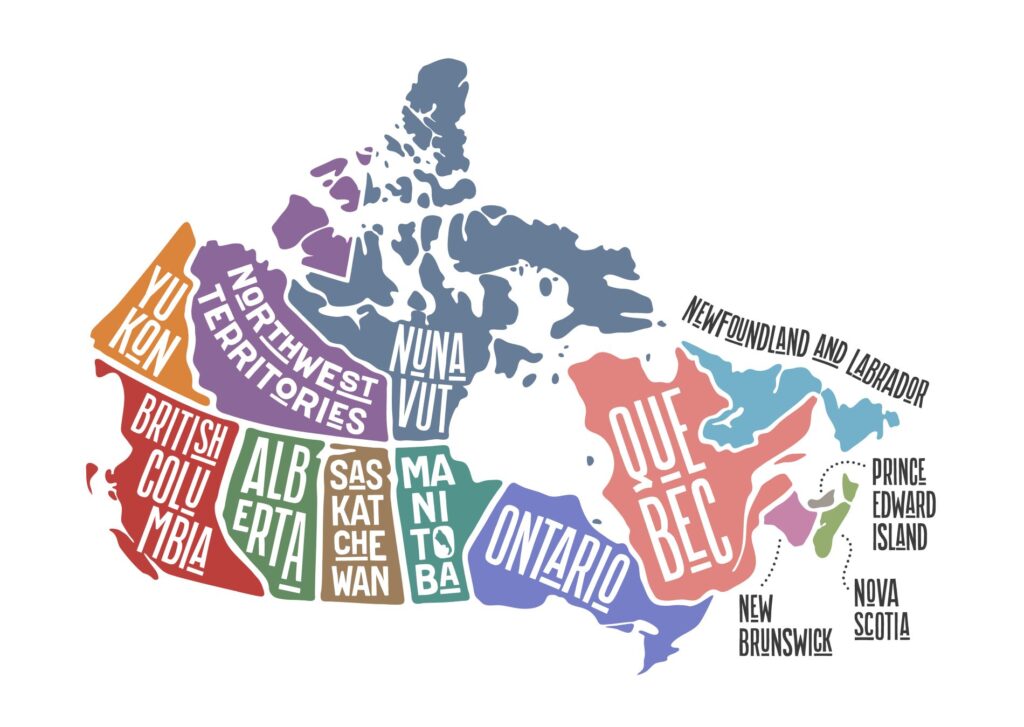
Insurance regulation is provincial and territorial, leaving Canada with 13 licensing regimes with fees, continuing education requirements, and rules for supervision and errors and omissions (E&O) insurance that vary widely.
The Canadian Life and Health Insurance Association (CLHIA) compiled a national survey with input from provincial and territorial regulators mapping out these differences.
Nova Scotia, Prince Edward Island and the Northwest Territories do not require E&O insurance. Nunavut does not formally mandate it either but asks new applicants for proof of coverage as evidence of financial responsibility.
Seven jurisdictions — New Brunswick, Newfoundland and Labrador, Nova Scotia, P.E.I. and all three territories — have no mandatory continuing education. Saskatchewan requires 15 hours from resident agents, while non-residents can satisfy the requirement through CE in their home jurisdiction.
Ontario has the lowest effective annual life-agent licensing fee: $170 for two years, or $85 annually. Quebec is substantially more expensive, with Autorité des marchés financiers (AMF) charging $116 per sector or sector class in 2026, plus a $462.20 annual contribution to the Chambre de l’assurance.
Alberta: licences starting at $60
In Alberta, life-agent licences cost $95 and A&S licences $60. Both are valid for up to one year, expiring June 30.
E&O insurance is mandatory. Unrestricted certificates require at least $500,000 per claim and $2 million in aggregate. Restricted certificates require at least $500,000 per claim and aggregate coverage of $500,000 per employee, up to $2 million.
Agents need 15 CE hours annually, due June 30, and may carry forward up to 7.5 hours. Sponsorship by a licensed life insurer is continuous until cancelled.
Initial LLQP exams cost $100 for all four life modules or $50 for the two A&S modules. Exams outside Calgary and Edmonton may carry additional invigilation fees.
British Columbia: carry forward up to a year’s worth of CE
In British Columbia, individual life and A&S agents pay $375 annually, while agencies pay $675. Licences are continuous, subject to annual renewal by June 1.
E&O insurance is mandatory, with at least $1 million per claim and $2 million in aggregate. Agencies with more than one authorized representative need a separate and distinct policy for each person.
Agents must complete at least 15 CE hours per licence year ending May 31 and may carry forward up to one year’s worth of credits.
New agents generally require at least two years of supervision, reducible by up to 12 months for applicants holding a CLU, CFP or RFP designation. Sponsorship is not required, but agents need written authorization to represent at least one insurer authorized in B.C.
LLQP exams cost $210 for all four modules written in one day in Metro Vancouver or $80 per module. Outside Metro Vancouver, modules cost $80 each, with additional proctoring charges at some test centres.
Manitoba: no CE carry-forward
Life-agent licences cost $150 and A&S licences $90 in Manitoba. Both are valid for one year and expire May 31.
E&O insurance is mandatory, with at least $1 million per occurrence and $5 million in aggregate. Agents need 15 CE hours per licensing year, with no carry-forward.
Sponsorship by a licensed insurer is continuous, and life agents are supervised during their first year.
The full LLQP exam costs $110. Rewrites also cost $110 per sitting, regardless of the number of modules written. Exams are offered in Winnipeg and surrounding areas as needed.
New Brunswick: exclusive insurer employees can skip E&O
In New Brunswick, life and A&S licences each cost $125 for one year. After two years, eligible agents may be offered a two-year licence. Licences expire March 31, June 30, Sept. 30 or Dec. 15.
E&O insurance is mandatory, with at least $1 million per occurrence and $2 million in aggregate, except for agents employed directly and exclusively by one insurer.
There is no mandatory CE. Sponsorship by a licensed life insurer is continuous.
LLQP exams cost $66 per module in person and $84 online.
Newfoundland and Labrador: E&O deductible up to $10,000
Life and A&S representative licences cost $125 annually in Newfoundland and Labrador, with filings due at the end of the anniversary month of issue.
Agents need at least $1 million in E&O coverage, with a maximum $10,000 deductible unless the superintendent approves otherwise. They also need at least $100,000 in fidelity insurance, again with a maximum $10,000 deductible unless approved.
There is no mandatory CE, and sponsorship by a licensed life insurer is continuous.
LLQP modules cost $35 each in person and $86 online.
Nova Scotia: three-year licences
In Nova Scotia, combined life and A&S licences and A&S-only licences each cost $398.10 and are generally valid for three years.
Neither E&O insurance nor CE is mandatory. Insurer sponsorship is required when applying for a licence, but not continuously afterward.
Online LLQP modules cost $84 each and in-person modules $95.
Ontario: A&S agents are exempt from E&O and CE
In Ontario, life and A&S licences each cost $170 for two years and expire the day before the anniversary of issue.
Life agents need at least $1 million in E&O coverage per occurrence and 30 CE hours during each two-year licensing cycle, with no carry-forward. A&S-only agents are exempt from both requirements.
Life agents generally need insurer sponsorship for their first two years, while A&S-only agents require continuous sponsorship.
In-person LLQP exams cost $66 per module. Ontario discontinued online LLQP exams on July 1, 2026, although accommodations are available where needed.
Prince Edward Island: LLQP exams generally online
Life and A&S licences cost $200 and are valid for two years in Prince Edward Island.
Neither E&O insurance nor CE is mandatory. Continuous sponsorship by a licensed insurer is required.
For 2026-27, LLQP exams cost $85 per module and are generally taken online through Durham College unless an accommodation or the superintendent requires in-person testing.
Quebec: the costliest annual licensing regime
Quebec has several insurance sectors and sector classes. The AMF’s 2026 renewal fee is $116 for each one held. Representatives in insurance of persons also pay a $462.20 annual contribution to the Chambre de l’assurance. Certificates renew annually, with the expiry month determined by surname.
Representatives must have professional liability coverage. Employees are generally covered under their firm’s or independent partnership’s policy. Independent and non-employee attached representatives need coverage for at least $500,000 per claim and $1 million in aggregate, with a standard maximum deductible of $10,000.
Representatives generally need 30 professional development units (PDUs) every two years. An additional sector adds another 10 PDUs. Up to five excess PDUs earned from Sept. 1 to Nov. 30 of an odd-numbered year may be carried into the next reference period.
New life representatives generally complete a 12-week supervised probationary period at 28 hours a week; A&S representatives complete six weeks at 28 hours a week.
The AMF’s 2026 fee schedule lists an $88 examination-eligibility fee and a $181 registration fee, for a total of $269. Rewrites require another $181 registration fee regardless of the number of modules rewritten. Exams are written with pencil and paper.
Saskatchewan: 50 policies during supervision period
In Saskatchewan, life licences including A&S and A&S-only licences both cost $125 annually and expire on the anniversary of issue.
E&O insurance is mandatory, with at least $1 million per claim and $1 million in aggregate.
Resident agents need 15 CE hours annually, with no carry-forward. Non-residents may satisfy the requirement through CE in their home jurisdiction.
New agents remain supervised until they have been licensed for at least one year and completed at least 50 placed and in-force policies.
Virtual LLQP exams cost $84 per module through Durham College.
Northwest Territories: two-year licences, no E&O or CE
Life and A&S licences each cost $214, while a combined licence costs $428. All are valid for two years.
Neither E&O insurance nor CE is mandatory. Continuous sponsorship by an insurer licensed in the territory is required.
LLQP fees are set by Durham College, the territory’s exam administrator.
Nunavut: E&O proof requested from new applicants only
Life and A&S licences each cost $100 and a combined licence $200. Licences are valid for up to one year and expire Sept. 30.
E&O insurance is not formally mandatory, but new applicants are asked for proof of coverage as evidence of financial responsibility. The CLHIA survey refers to per-claim coverage of $1 million to $2 million.
There is no CE requirement, and continuous insurer sponsorship is mandatory.
LLQP fees are set by Durham College. In-person exams can be arranged in Iqaluit or other communities as required.
Yukon: E&O for self-employed agents only
Annual life including A&S licences cost $200 for non-residents and $100 for Yukon residents. A&S-only licences cost $100 for non-residents and $50 for residents. Licences expire Sept. 30.
There is no mandatory CE.
E&O insurance is required only for self-employed agents, with at least $500,000 per claim and $1 million in total coverage. Agents associated with an agency or employed directly by an insurer do not need to provide proof.
Sponsorship is continuous. Agents must provide an insurer recommendation for each insurer they are authorized to represent in Yukon.
Virtual LLQP exams cost $84 per module through Durham College.