


Companies around the world continue to increase their use of AI technology, according to a new study released by McKinsey Global on Tuesday. But while individuals are reporting productivity gains, “enterprise-level financial impact hasn’t followed the same trajectory.”
Fewer than two in five organizations (37%) told the consultancy that AI has contributed to their earnings before interest and taxes. That figure is unchanged from last year’s edition of the same study. Meanwhile, “AI-related operating costs are beginning to constrain AI use for about one in five organizations.”
The cost pressures are real, even as optimism about the potential impact of AI remains high. McKinsey reported that close to one-third of respondents decided against buying software because they can now build it themselves using AI coding tools.
In May, the Deloitte Center for Financial Services released its own report, “The agentic AI productivity wave is heading for wealth management.” It predicted that agentic AI will deliver something between a 30–100% boost in advisor capacity by 2032.
“At an industry level, that implies that between 25% and 50% of advisor time could be freed from lower-value operational work,” according to the report.
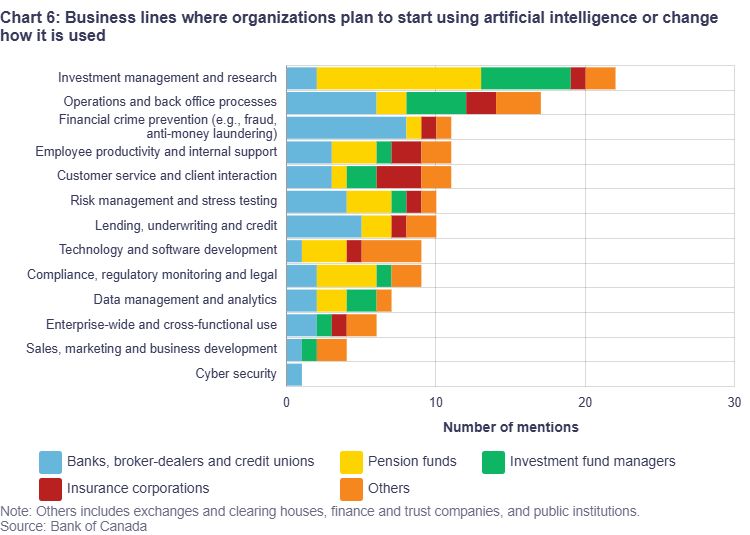
Also in May, the Bank of Canada (BoC) published the results of its 2026 Financial System Survey. “Nearly all respondents reported using AI, with most reporting limited or moderate use across a wide range of business functions,” according to the BoC’s highlights report.
And they have big plans for the next two years, including investment management and research, operations and back-office processes and employee productivity.
It’s not all smooth sailing though. According to the BoC report, 58% said they’re having “difficulty integrating AI into existing infrastructure and workflows” and 56% “reported talent‑related constraints, pointing either to insufficient AI literacy skills among existing staff or difficulties hiring and retaining employees with AI‑specific expertise.”
That rings true for John Connell, CEO and co-founder of Focal AI, a provider of AI solutions to the Canadian wealth management industry.
“A lot of it is implementation,” he said, in an interview Tuesday.
Onboarding new technology has long been a challenge in the industry. Investment Executive’s Report Card series has tracked this phenomenon for decades. The uncomfortable truth is that long-tenured advisors who’ve gotten comfortable serving clients in a particular way struggle to adapt or resist new technology outright. That can turn a change-management program into a morale-buster.
“The best firms are doing a really good job of defining success metrics upfront,” Connell said. “Instead of just handing every advisor a login and hoping adoption happens.”
While some advisors resist the new tools, others use unauthorized off-the-shelf tools without their firm’s knowledge.
“You would be surprised how often shadow AI becomes a big issue,” Connell said.
That can lead to compliance problems — client conversations can be recorded without either the advisor’s or client’s knowledge and client data can be uploaded without permission.
These individual solutions have another consequence — they obstruct a firm’s ability to move from the use of discrete AI tools to agentic AI, in which tools interact across multi-step advisor workflows to complete tasks, like automatically updating a customer-relationship management (CRM) file with AI-produced meeting notes.
“If your AI still requires you to re-enter information into your CRM or your planning tool, you’re missing out,” Connell said.
Resistance among advisors who fail to recognize the productivity gains made possible by this shift to agentic AI threaten their firms’ competitiveness at an increasingly critical time.
“If you don’t, you lose out,” he said. “Competitors move faster.”
Connell slips into marketing mode here: “We’re building an Iron Man suit. Tony Stark is still flying it. He’s just a lot more capable than he was beforehand.”
It’s not the technology slowing down the productivity gains and return on investment firm executives are counting so heavily on. It’s adoption. Some firms are more aggressive than others, but that’s not where the real friction is right now. Advisor adoption is the key.
“There’s a lot of folks operating with an ostrich perspective,” Connell said.