
Comparisons between today’s AI-driven equity rally and the late-1990s dot-com bubble miss a fundamental difference between the two, says Tiago Figueiredo, a macro strategist at Desjardins.
Figueiredo co-authored a note to investors this week, with Jimmy Jean, vice-president, chief economist and strategist at Desjardins.
“Economic activity remains strong, particularly in the U.S., and that has been supporting earnings growth,” they wrote. “Firms connected to AI, energy, infrastructure and strategic supply chains stand to benefit directly from the resilience of the investment cycle.”
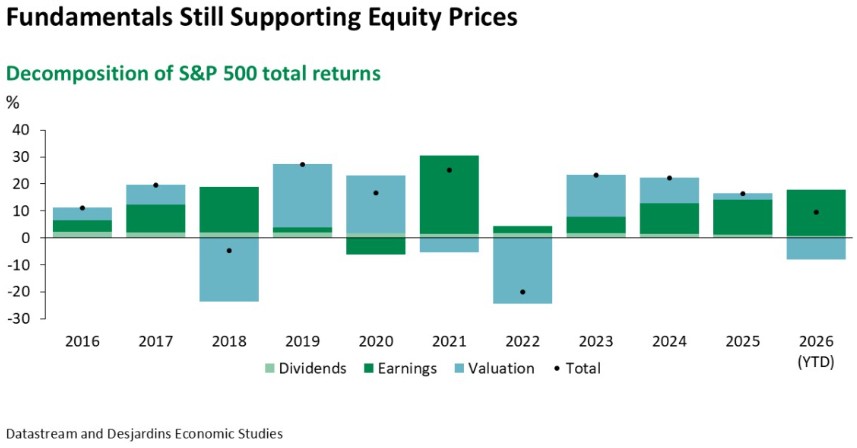
Figueiredo told me in an interview Wednesday that unlike the roaring ’90s, the AI trade “isn’t a valuation story necessarily.”
Figueiredo has been taking a hard look at equity return drivers. “In the period running up to 2000, a lot of the increase was valuation growth,” he said. “It is very much a concentrated economy right now as a result of AI. But the earnings growth is there. This isn’t a valuation story necessarily.”
“Valuations on the broader index have actually been moving lower, and same thing with information tech as a subsector,” Figueiredo said. “[Price-to-earnings ratios] have been moving lower as well. So, the earnings forecasts are there, and even the realized rates that we’re seeing have been beating expectations.”
He’s right about concentration risk, of course. The Magnificent Seven accounted for about 25% of S&P 500 earnings last year, a number that is forecast to climb to 27% this year.
But that’s about half the concentration risk facing South Korean investors. Samsung Electronics and SK hynix are expected to account for about 47% of Korea Composite Stock Price Index profits this year.
Bond issuance
Pat Bolland reported for us last month that U.S. hyperscalers are issuing debt to fund the AI infrastructure buildout. As of last week, Amazon, Alphabet, Meta, Oracle and Microsoft have issued US$194 billion in debt this year, according to Reuters. That represents about 11.5% of total U.S. corporate bond issuance.
That has investors worried about borrowing costs, as heavy issuance can put upward pressure on corporate bond yields.
Figueiredo said he’s less concerned about that after last week’s quarterly refunding announcement from the U.S. Treasury.
“There was a slight change in the language, which went from potential increases in Treasury issuance to changes in Treasury issuance,” he said. “What that makes me think is [U.S. Treasury Secretary Scott Bessent] has at least opened the door to potentially less coupon issuance in the U.S.”
There’s still interest rate risk there, but Figueiredo said there are ways to mitigate it.
Desjardins is not forecasting any rate hikes in the second half, from either the U.S. Federal Reserve or the Bank of Canada (BoC). It expects two BoC hikes next year, a call that’s contingent on how trade talks with Washington play out.
“If we get a deal done in the next couple of months, that could remove a lot of the uncertainty,” Figueiredo said. “We could even see some of those rate hikes happen this year.”
He’s optimistic about those negotiations, and about the outlook for the Canadian economy. “The economy may have bottomed,” he said.
South of the border, Figueiredo said it would take “an exogenous factor” to slow growth substantially. This week’s producer price index and consumer price index reports from the U.S. Labor Department showed stable, albeit elevated, inflation rates that investors read as supporting expectations that the Fed will remain on hold.
All of which makes it premature to equate today’s AI trade with the late-1990s bubble. The earnings and spending are real, even if it remains unclear what kind of returns all that spending will generate. The question remains — if AI adoption slows, a large number of bets are off.